General Description
The festival is hosting 53 games by game makers from 23 countries. All games will be playable throughout the festival. Link to the online stream is here (old link).
Each game is curated into thematic categories, with presentations by the game makers (in-person or online). Expert commentators who will lead Q&As further unpacking the games’ meaning and write reviews. The games have two types of presentations:
Friday & Saturday: Games have 5-minute presentations by its makers. Digital game presentations will take place in Paidia (link shows entrance photos). After each presentation, a host will do a 5-minute Q&A. After those presentations there will be a one-hour window focused on playing those games on computers publicly available in Paidia. Larp as Art games will have a 5-minute presentation by the makers in Näty Theaters (link shows entrance photos), if you want directions see this map connecting the two locations, at the beginning of each session followed by a run of those games. All larps will meet in the Näty theater lobbies before walking to their specific locations: Teatterimonttu, the black box rehearsal space, the white box rehearsal space, or Ludus.
Sunday (Main Showcase): Games have a 15-minute presentation by its makers in Paidia. The festival will have a 2-hour play session focused on those games. Then, there will be a 1-hour Q&A panel discussion between the expert commentators, the audience, and the game makers.

Click the session names for more details please… those triangles love being clicked to expand for more details.
Friday October 9th
Festival Opening by Leland Masek, Director of the Games As Art Center. (17:00-17:30, Paidia)
Alternative Bodies — (Larp As Art Session 1, 17:30-22:00, Näty theaters): Base Notes, Bed of Reeds, The Life of a Moth, Rhizome: Becoming
Alternative Bodies
What guides the body in a live action role-playing game? What are the boundaries and meanings of letting our body act in an alternative or even transgressive manner? This session explores this topic through the lens of allegorical animals, non-visual senses, and our relationships to the city around us.
| Base Notes (Teatterimonttu) |
|---|
| Base Notes invites you on a near-future, nose-on journey through a labyrinth of scents, riding an inherited sillage upstream that breathes across generations. A couple of lifetimes back, your ancestral homeland was left behind. Life drifted elsewhere. While the hope of tomorrow sustains, a submerged longing remains, waiting for the air. Alongside a diaspora of fellow descendants, you step into the custody of ancestral echoes swirling around you. How might your breath attune to this more-than-human smellscape? What has stood through the deep, and what dreams and drafts do these shapeshifters whisper to those who still listen? Base Notes is a nose-first experiment to celebrate our primal sense of smell and revive our visceral intelligence through play. Grounded in an archaeology of the future and ancestral wisdom, this speculative playground offers a spirited antidote to the pervasive anosmia of our times, while tending the roots of creative regeneration. Trust your snout, follow the trail, and activate the blueprints these airborne fragments hold for worlds we have yet to breathe into existence. |
| Cathy Li is a practitioner-researcher, designer, and facilitator for social and sustainable good, building the playgrounds where participatory regeneration and collective intelligence take root. By decoding, developing, and facilitating the interplay between complex challenges and diverse groups of actors, she fosters cross-sector collaborative ecosystems and first-person experiences that resonate and scale deep. She works closely with organizations and local communities worldwide, as well as fellow living beings like apes and fungi. Cathy is the founder of Knot to Play, an initiative nurturing futures literacy through transformative play. She is a lifelong player and an enthusiast for ruins, maps, and folk games. |
| The Life of a Moth (black box rehearsal space) |
|---|
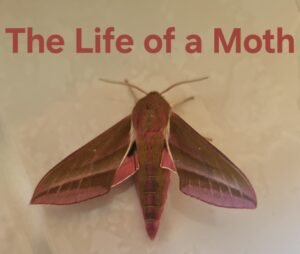
| Life of a Moth is an allegory on the disruptive power of smartphone use / social media in our lives. Players play a group of moths and follow different events in their lives. In this larp, moths are quite anthropomorphized, they have social relations like humans and also live through similar events. However, there is one crucial difference. Once a bright light is lit, it doesn’t take long until this light seizes all attention and the moths can’t help but dance around it, no matter what they were doing before. For Players: If possible, please bring a scarf or towel, which could function as your moth wings. |
| Olivia Fischer is an Austrian larp designer, mainly working with the non-profit larp collective “1000 Atmosphären”. Olivia has been designing and running larps since 2002 – many of them with a transformative, sometimes educational intention. She wants to promote larp as a form of art and as a means for transformation, while also acknowledging that larp can exist without any of these demands, just as a form of entertainment or self-expression. |
| Bed of Reeds (white box rehearsal space) |
|---|
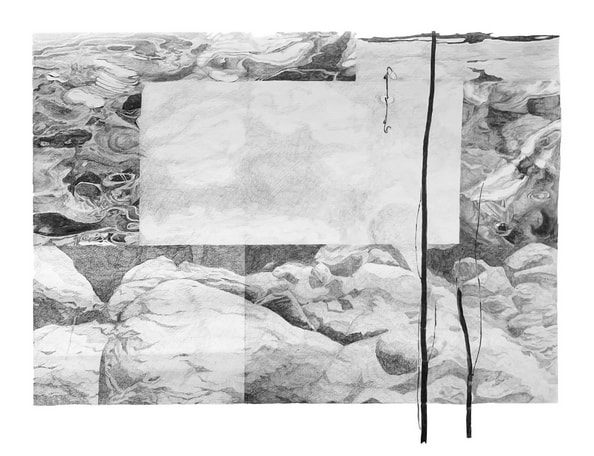
| A woman has begun to wear the skin of a pike and is slipping away from the world of humans. Her loved ones gather for a ritual to force her into her old form so they can coerce her to stay. Yes, this is a trans-allegory. This folk horror fable about the loved ones of a shapesifter explores the friction between cultural norms and transitions that transgress them. The shapesifter is played by the designer and is influenced by her own life as a trans woman. Will contain ecofeminism: like all stories of beasts and men, this is a story about violent control. May contain a happy ending in the form of letting the shapesifter go. Picture: Väinä Räsänen. Dialogue on critical animal studies: Helinä Ääri. Supported by the Finnish Cultural Foundation and the Finnish Arts and Culture Agency. |
| Pihla Lehtinen is an artist based in Helsinki & Turku, Finland. Working in larp design and spoken word she emphasises queer as an artistic position and cross disciplinary practises both between art forms and between art and science. Otherness and bodies are a recurring theme in her work. Currently she’s exploring them in a framework of queer monsters in a three year project funded by the Finnish Cultural Foundation and the Finnish Arts and Culture Agency. |
| Rhizome: Becoming(Outdoor Pervasive Game) |
|---|
| Rhizome: Becoming has two factions compete for control over a fictional network infrastructure that is overlayed on the map of a given geographical area, between two asymmetrical teams. “The System” defends a centralized control network infrastructure, while “The Opposition” tries to sabotage that infrastructure. These actions are performed by the players physically moving around, capturing nodes, and risking being de-anonymized. The game takes place on real streets and at landmarks, where players embody their faction’s interests by holding a position to capture it, running to intercept a saboteur and interrupting an attack, or verifying an opponent’s identity face-to-face. The game culminates in a tense final scene, where the identity of an Opposition agent is either revealed to the System or remains hidden. |
| Iuliia Sharipova is a Master’s student in AI&Data Science at the University of Trento and a former fintech software engineer. Her earliest memories include playing Tomb Raider 2 on an old Macintosh and spending time playing outdoor games with other children, where her interest in exploration first emerged. She sees games as a way to study complex systems by transforming them into interactive experiences, where the player becomes a part of the world’s internal logic – often with elements of irony and symbolism. The project originated as a course assignment under the supervision of Professor Lorenzo Lin Angeli. |
Life in the Garden (Interactive Book, 17:30-18:00, Paidia)
| Life in the Garden |
|---|
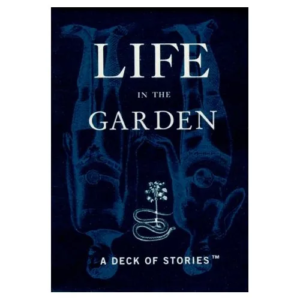
| A meditation on the Garden of Eden myth, Life in the Garden is a book where you shuffle the pages and create a new story every time. Like a surrealist language game in reverse, Life in the Garden creates a coherent story every time you play. With more than 50 pages, each printed with a unique illustration, the possibilities are vast. |
| Eric Zimmerman‘s professional life is about inventing new ways for people to play and teaching others about the craft and relevance of games. He has taught at MIT, NYU, Parsons School of Design, The School of Visual Arts, and has led hundreds of classes and workshops on game design around the world. He is a founding faculty and Arts Professor at the NYU Game Center, Tisch School of the Arts. |
Ironic and Meta — Breaking the fourth wall & Maybe There are Some Minor Problems with Capitalism, (Video Games As Art session 1, 18:00-20:00, Paidia): Lestvica: the Analog Current, Let Me Play!, the shape of worlds to come, Academic Quest, Soul Injector Commando, Anti-work simulator
Breaking the Fourth Wall w/ host Aska Mayer
Some games have characters, other games speak to us as players. These games do both: they utilize layers of messages both meant for “in-game” and some meant for “out-of-game”. If you like games in multiple languages, games that call you out as a player, games that open up real-world philosophical questions, then this is the session for you!
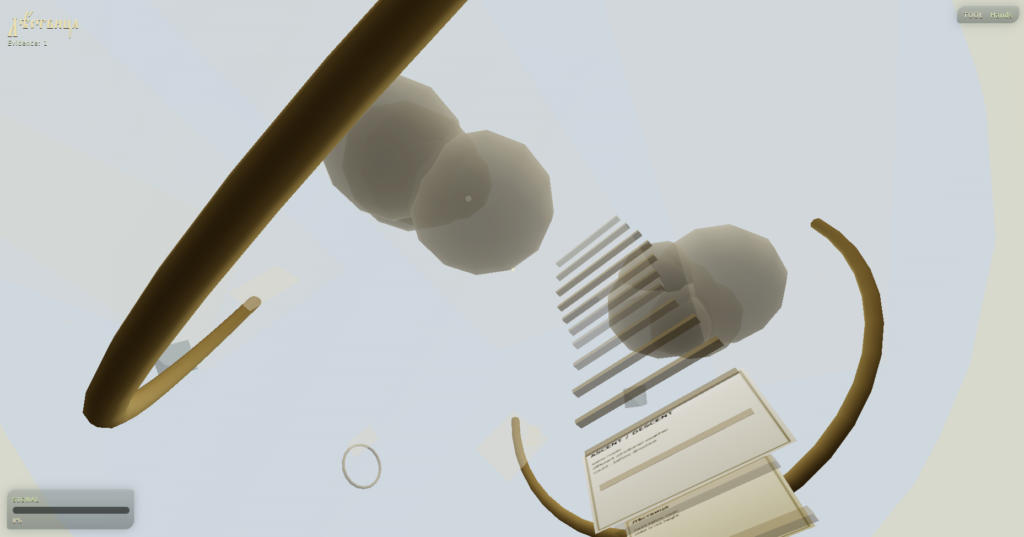
| Lestvica: The Analog Current (video game) |
|---|
| Lestivica: The Analog Current is a first-person exploration game about signals, archives and linear objects in border zones. Inspect objects, collect evidence, switch between specialized viewing tools and arrange fragments on your Field Desk. Progress depends on observation, spatial reasoning and recognizing repeated structures rather than combat. Try to pass in multiple languages, from English to Church Slavonic, Interslavic, Sanskrit, Polish, Toki Pona, Russian and others. The Ladder is text-heavy and multilingual, with its languages being the part of the archive’s texture itself. |
| Ꙋм (in-person presenter) is an independent game maker exploring games as art through ritual, memory, architecture, and experimental sound. Creator of experimental video art, VR game art experiences, and recently, Лѣствица (The Ladder), exploration mystery game going through forests, railways, machines, and forgotten sacred spaces. |

| Let Me Play! (video game) |
|---|
| After shouting “Let Me Play!” to the cast in a theatre, the fiction comes crashing down as everyone, including you, becomes aware they’re only following a script. Will you let the play continue? Or will you write your own ending? Let Me Play! is a short text adventure / visual novel about a play that doesn’t let itself be played by the player. The project started as a lighthearted poke at very old discourse surrounding player freedom in games. It quickly turned into an overly-meta fiction that was also heavily inspired by “Six Characters in Search of an Author” by Luigi Pirandello, “The Entertainment” interlude in Kentucky Route Zero, as well as by many meditations on the intersections between games, theatre, and play. |
| ‘Interactive Dreams’ (online presenter) (games, poems & dreams) is a small studio from Mexico that specializes in short narrative adventures that deal with topics such as nostalgia, melancholy, and anxiety. Formed by 3 core members, and external artists that rotate each project, Interactive Dreams has published a variety of games that have earned positive reviews from players, highlighting the writing and approach to philosophical themes. The studio believes in pushing definitions of what games are and can be, and as such, don’t feel committed to creating “fun projects”, instead, relying on generating thought-provoking and emotional-heavy interactive experiences that make use of the medium not only as a way of engaging players, but also as a way of making them uncomfortable and challenging their assumptions. |
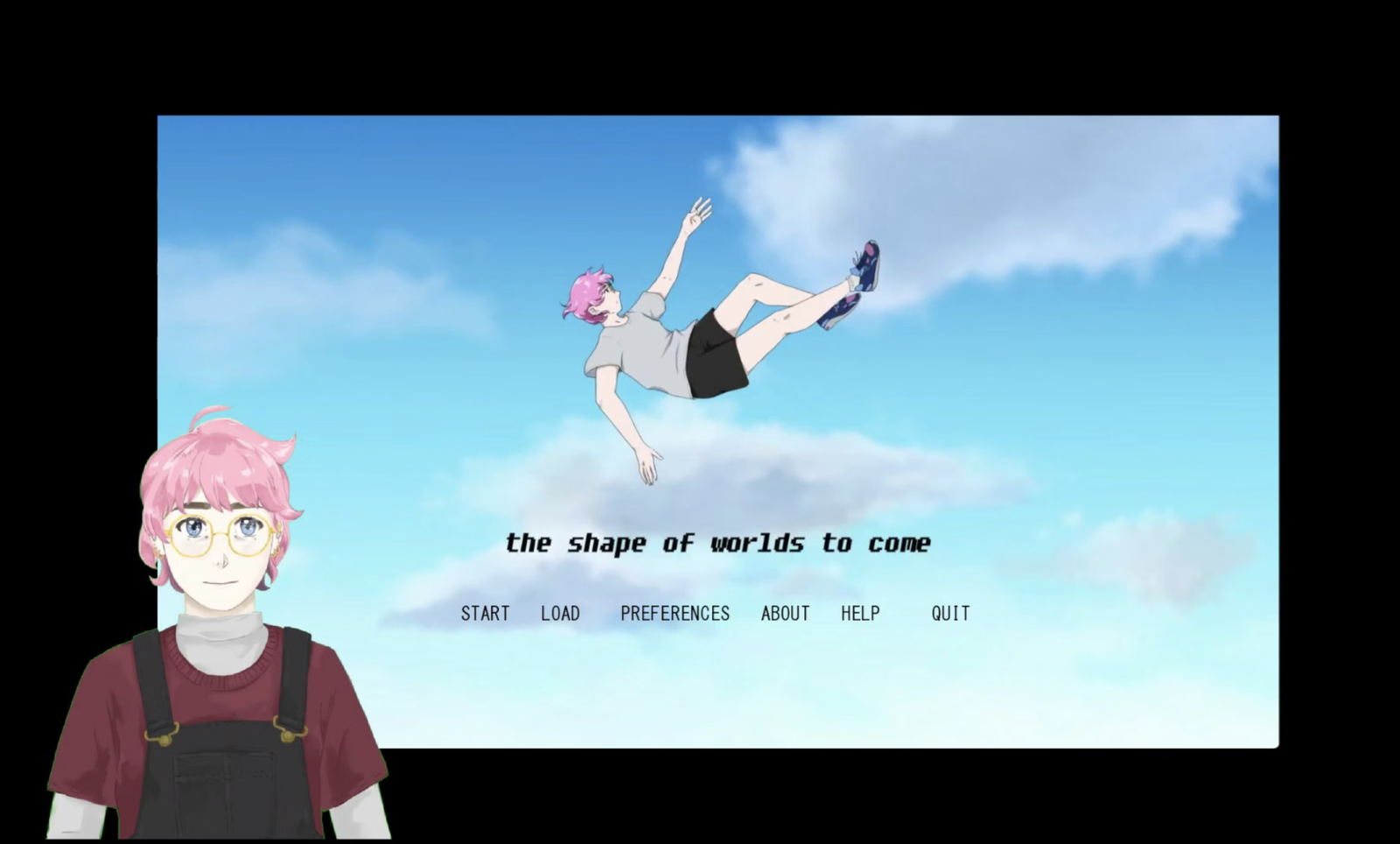
| the shape of worlds to come (visual novel) |
|---|
| The shape of worlds to come is a short branching-narrative game that serves as a tool to think about the shape of clouds, rail crossings, and death. Journeying through multi-planar realms and conversations, the protagonist muses on the conditions of life under a game-like realism. Produced with support from Nitja Centre for Contemporary Art. |
| Petra Szemán (online presenter) is a moving image artist working with animation and game-like landscapes. Their practice focuses on the murky borderlands along the arbitrary line separating real and fictional, and the kind of lives and experiences that are possible there. Using a virtual version of themself as a protagonist journeying through animatic realms, they explore liminal spaces and threshold situations, looking to dissect the ways our memories and selves are constructed within a landscape oversaturated with fiction (both on- and off-screen). Turning away from thinking of the cyberspace as a radically ’other’ realm, Petra hopes to walk the line situated between dystopian and utopian frameworks, eyes set on new queer horizons. |
Maybe There are Some minor Problems with Capitalism w/ host Julián Gutiérrez Carrera
I don’t mean to be too radical here, but every once in a while I wonder if some things don’t need to be about making money… Maybe… These games discuss capitalism in a nuanced and respectful manner. Whether it’s your university stealing your crypto-wallet, the uncontested joys of having your own cubicle, or “retiring” billionaires by giving them souls (and real jobs), these games let us reflect on the joyful beauty of capitalism in all of its forms.
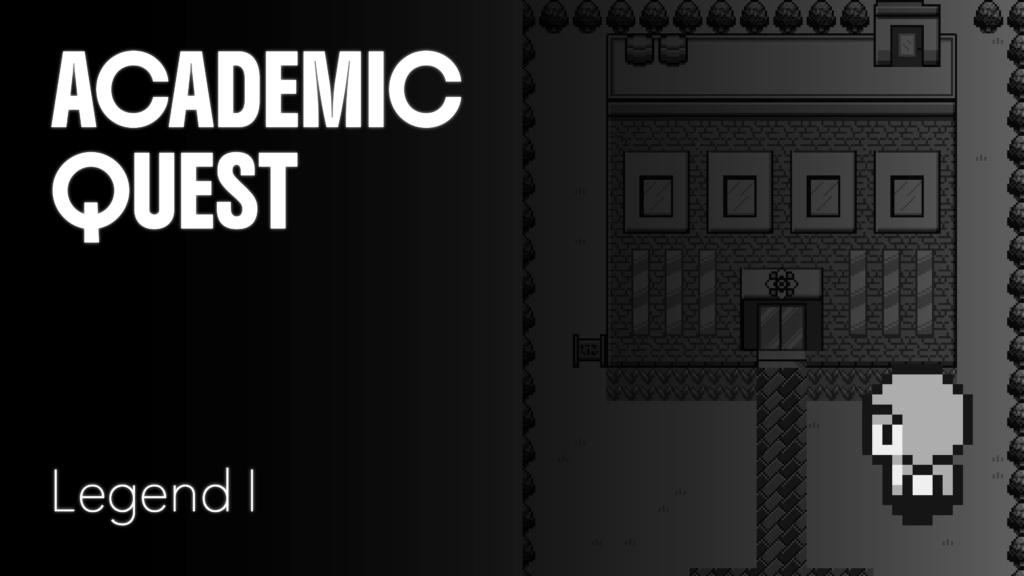
| Academic Quest: Legend 1 (game boy game) |
|---|
| Academic Quest: Legend 1 is a modern Game Boy game in the tradition of classic RPGs like the Final Fantasy Legend series. AQ1 is a satire focused on the student experience of the modern, profit-driven university. In order to graduate, a student must convince the trustees to return the university’s cryptocurrency wallet passphrase. |
| Travis DuBose (online presenter) is Associate Teaching Professor in the department of English & Communication at Rutgers University in Camden. He makes games under the nom-de-studio Two-Headed Boy. |
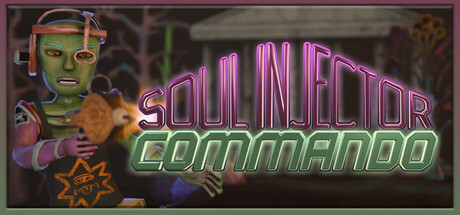
| Soul Injector Commando (first-person shooter) |
|---|
| Soul Injector Commando is a chill and surreal FPS where you are tasked by God to go on an underground adventure with some friends to give souls to the greediest people on Earth. God has found a list of all the billionaires in the world on forbes.com and she has trapped them in an underground bunker. She has tasked you to descend into the underground labyrinth to inject souls into every single one of them, helping them to become normal people and get normal jobs. As you go deeper and deeper into the bunker, you make some friends along the way and find new tools to help you on your quest. |
| Jeremy Couillard (online presenter) is an artist and game designer currently based in Kassel, Germany, where he is professor of the Games Klasse at the Kunsthochschule Kassel. Besides the project being submitted here, he has published five other games as well as created art exhibitions around them, exhibiting mostly in the USA but also in Germany and at the Fiskars residency in Finland. Some recent exhibitions include Escape from Lavender Island at the MIT List Center, in Boston, curated by Natalie Bell, as well as Fuzz Dungeon, at Denny Dimin gallery and JEF at Times Square Space, both in New York City. |
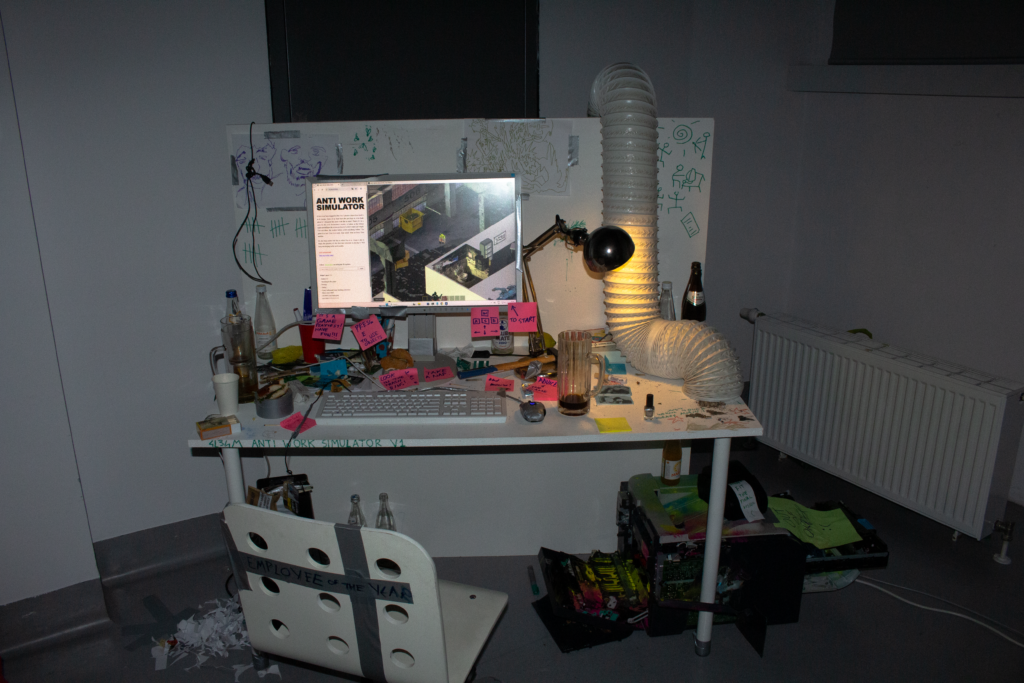
| Anti-Work Simulator (video game) |
|---|
| If u’ve ever been trapped in the 9to5 prison u know how hard it is to escape. Some of us don’t have the privilege to even think about it. I designed this piece with that in mind. Think of it as a gym for the civil disobedience muscle. A button in the bottom right camouflages the screen as Excel if you don’t wanna get caught. You’re not alone: the worker before left u something behind. The game is a tool. Use it at work.Start small. Steal an hour. Then another. |
| My name is Alessandro Ambrosini (online presenter), and I work as 4L34M. I’m a multimedia artist moving between video, VFX, graphic design, live performance and interactive installation. I studied film in Milan and I’m currently in the Interface Cultures master programme at the Kunstuniversität Linz. My work keeps returning to the same questions: what systems do to bodies, what bodies do to systems, and where the friction between the two becomes visible. Recent works include Epitaph 2048 (Milan, 2025), on the persistence of the digital self after death, and Dove nascondersi quando tutto scorre (Turin, 2026), on the impossibility of stillness in a world of continuous data streams. ANTI-WORK SIMULATOR is my first work made fully inside a video game and develope. It was awarded 3rd prize at the AK-Kunstpreis 2026, Kunstuniversität Linz, and first shown at the Linz Rundgang 2026. |
Joy and Connection — Cute & Yearning Humans & Connecting with Nature (Mostly Birds), (Video Games As Art session 2, 20:00-22:00, Paidia): angel garden, Whirlight No Time to Trip, Deathwish Bloom, Snow Flow, Biome, Sparrow Warfare
Cute & Yearning Humans w/ host Chris Aylott
Gosh humans can be cute. Whether you travel across time, try to cure a catastrophic illness while also bonding with people, or whisper little wishes to internet angels, we’re willing to do a lot to connect with people. If you want to play around with the desire of humans to connect, then here it is!
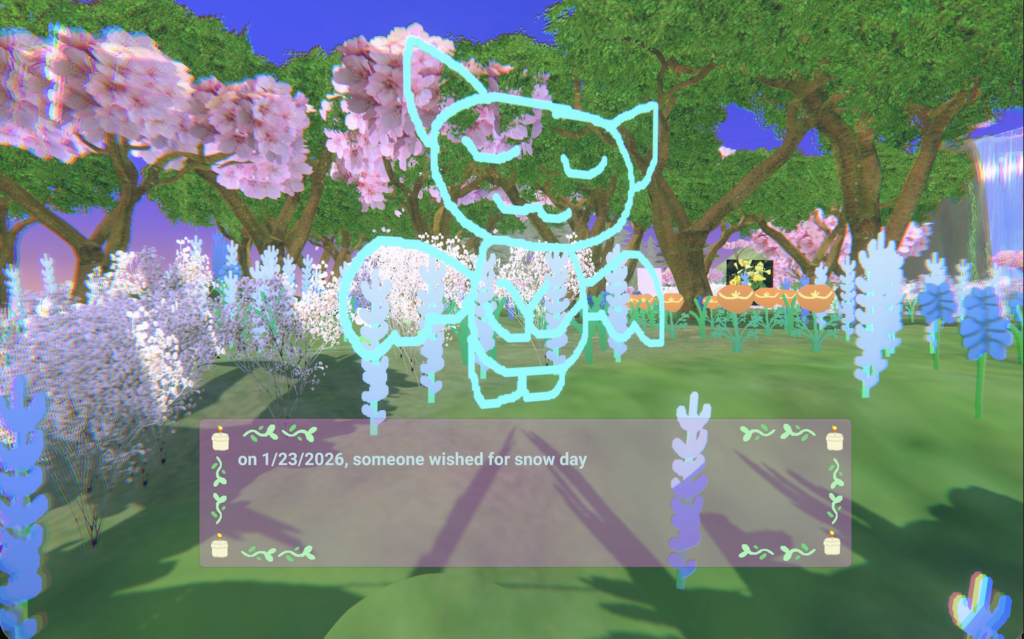
| angel garden (asynchronous digital experience) |
|---|
| angel garden is a massively multiplayer asynchronous experience, a place for wishing and eavesdropping on the wishes of others. Find special spots in the garden to wish from, and then by talking to the angels you can read the wishes of other real players who came before you. This interaction is inspired by messages written in sharpie on bathroom walls, and connection found deep in video comment sections. Anonymity has a reputation for breeding cruelty, but it also has a great capacity to reveal our humanity to each other. By creating a serene space and asking people to make a wish, the garden is able to draw out something from people and then reveal that something to others. I’ve filled the garden with talismans of internet and pop-cultural deities designed to created a feeling of divine protection — it’s safe to dream here. |
| Flan Falacci (in-person presenter) is an experimental game artist, teacher, and community organizer. Their work focuses on 3D spaces and walking sims, often collage/”plunder” style — utilizing found materials. They also made Titanic II: Orchestra for Dying at Sea, and Museum of the Saved Image, and collaborated on Terminal 64 and Terminal 69 with Big Bag. |
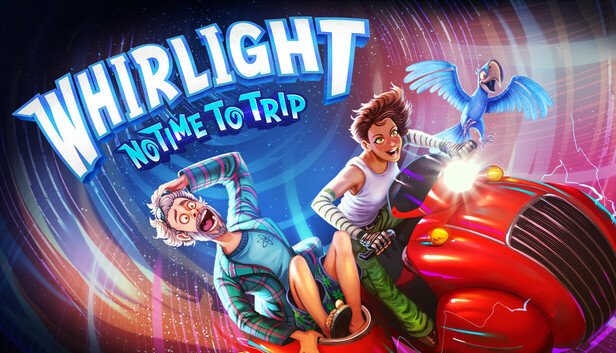
| Whirlight No Time to Trip (point-and-click adventure) |
|---|
| Whirlight – No Time To Trip is a humorous sci-fi adventure about time travel featuring two protagonists, dozens of puzzles, strange worlds, eccentric characters, and a long, story-driven experience. At its heart, Whirlight is about the beauty of connection: between people, between eras, between a world carefully built and the player invited to inhabit it. Every location, character, and puzzle was designed to reward attention and spark wonder. Visually, the game uses a hybrid 3D-to-2D pipeline to create hand-crafted environments of exceptional depth and warmth. We would like Whirlight to be presented not only as an adventure game, but as an interactive story about curiosity, empathy, and the possibility of change. Through exploration, puzzle-solving, and encounters with a diverse cast of characters, players are invited to experience time not as a straight line, but as a web of relationships, choices, and shared histories. |
| imaginarylab (online presenter) is an independent Italian game studio founded by three lifelong adventure game enthusiasts united by a passion for storytelling, puzzle design, and classic point-and-click games. Ciro Camèra: Founder and 3D artist. A full-time 3D artist that works on different projects ranging from architectural rendering (exteriors and interiors) to asset creation for software houses, to commercials and everything else in which 3D graphics are involved. Massimo Origano: Founder and software engineer. In the team he has the role of solving, through code and scripts, any problems that are encountered in the development phase. Emiliano Salardi: 3D artist and animator. His area of expertise deals with animation, especially character animation. |
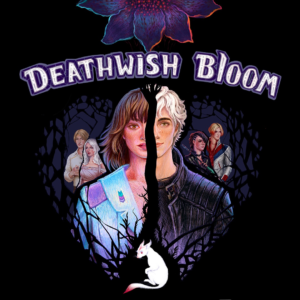
| Deathwish Bloom (visual novel) |
|---|
| Deathwish Bloom is a hand-drawn romance mystery visual novel, its thousands of coloured pencil strokes mirroring the quake-ridden post-apocalyptic setting. You play as Sky, an impostor scientist racing to recreate a cure only she knows existed. Her survival depends not on technology, but on a hidden, complex relationship system that governs her ever-shifting bonds with lovers, friends, and enemies. Every connection makes it harder to avoid what each of them would rather bury than remember. As Sky pursues her obsession, she is forced to confront unbearable memories, split off by the psyche as too painful to witness, and find redemption by welcoming those lost parts back, both in herself and her loved ones. At its heart, Deathwish Bloom is about connection after irreversible harm. What was lost was real. But what comes after is real too. It can grow into something beautiful, even if it’s born of loss. |
| Irina Kuksova (online presenter) is a lifelong visual artist trained in painting at Brera Academy of Fine Arts in Milan, Italy, and is now based in Belfast, Northern Ireland. Following her team winning the all-Ireland IndieDev Prototype Grant in 2025, she founded Sharp Glass Games Ltd with a mission to create delightfully hand-drawn Visual Novels that explore the complexity of the human psyche and make players laugh and cry while experiencing life through the eyes and hearts of her characters. Although Deathwish Bloom is her first game, she is backed by 10+ years of creating hand-drawn art, digital graphics, and art direction for the film industry in Ireland and the UK. She contributed her artistic skills to BAFTA 2025 Production Design winner “Rivals” series and ‘The Green Knight” feature film, for which she holds an ADG certificate for contribution to Excellency in Production Design. |
Connecting with Nature (Mostly Birds) w/ host Chris Aylott
Sometimes, connection happens with no-people-involved. In this session we will explore the beauty of nature connecting, thriving and bonding. While most of this “nature” is actually birds, there are technically other things bonding too. Also sometimes birds fight, it’s a type of connection!
| Snow Flow (video game) |
|---|
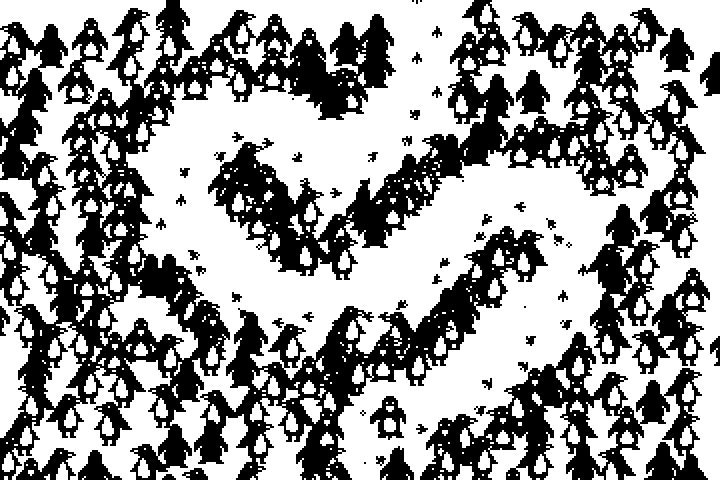
| Snow Flow is a calming day in the life of a penguin. Explore a densely settled ice shelf in this slice of life experience, one floppy foot at a time. Leave traces in the snow, slide around, and even push other penguins around as you make your way through the island. There’s also a soundtrack that changes ever so subtly as you move from one part of the isle to the next. Though you start off alone, there’s more to be found and done. You can even find a mate, find a place to nest, and hatch an offspring that you can explore with. The lack of direction lends a feeling of puzzle solving as you advance through the experience. Ending with a small family of your own caps the experience off with a feeling of completeness, despite having no preset goal at the start. |
| Jon Topielski (in-person presenter) is an American game developer from Brooklyn, NY and current MFA candidate at the NYU Game Center. His work spans multiple genres from puzzle to strategy to sport and is often displayed through a retro, pixel-art aesthetic. Some notable titles include Puzzle Sigma, a game where you solve puzzles with mathematical operators, and Pillow Fight, a deck building game where you battle various enemies of sleep such as “noise” and “light”. His work has been featured in publications such as PCGamer, EuroGamer, and Game Maker’s Toolkit. Wesley Olmsted, also known as “After Wes”, is an American electronic music producer based in Brooklyn, NY. He makes exploratory dance music that is modern, melodic, and deftly textured, informed by both hip-hop and hyperpop. His musical style has crossover appeal, be it in a wholesome game or on a thumping dancefloor. His notable songs include “way out west” and “i feel alone, and it’s cold outside”, which together have nearly 3 million plays on Spotify. |
| Biome (sandbox simulation) |
|---|
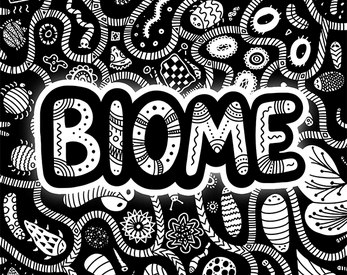
| Biome is a relaxing, sandbox, ecosystem simulation game. Water your plants to populate the world, gather pollen, manage the population of bugs, unlock new ones (each with its own traits) and watch a (relatively) peaceful food chain emerge. |
| Based in Athens, Gray Owl Games (online presenter) creates games, digital environments, and interactive experiences that explore the relationship between humans, their environment, and the systems that compose it. From museum applications to research‑driven or experimental games, Gray Owl Games focuses on works that highlight observation, clean aesthetics, and calm, carefully crafted interaction. |
| Sparrow Warfare (video game) |
|---|
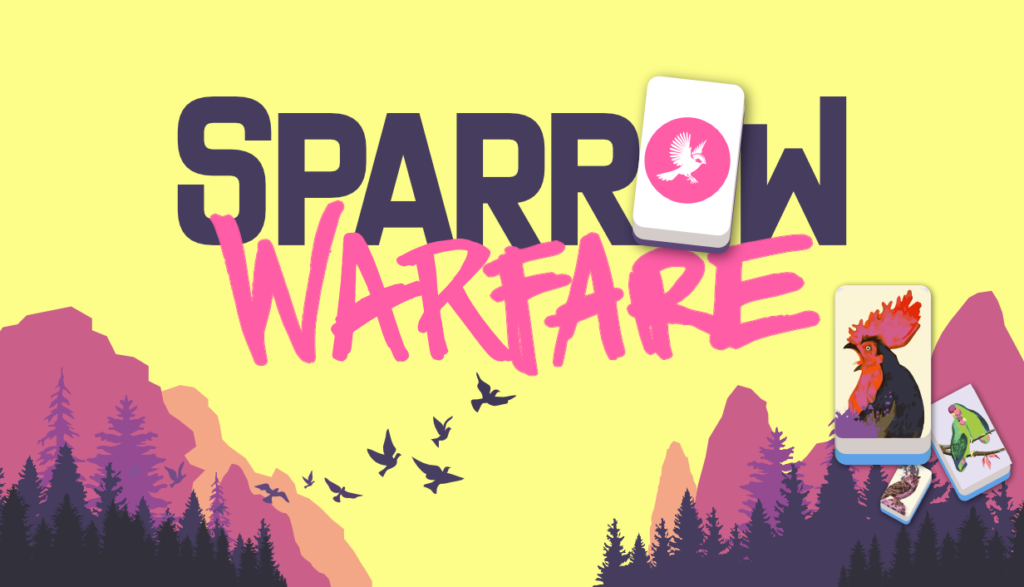
| Birds, tiles, and freedom: Sparrow Warfare is a strategic deckbuilder with roots in mahjong. Combine sets of three tiles to free birds and progress, unlock wildtiles to make crazy combos, and lead your magnificent bird army to freedom! |
| Made by a team of 2 award-winning veteran game developers: Martin Pichlmair and Charlene Putney (online presenters), who have 25+ combined years in game development (Divinity: Original Sin 2, Secrets of Rætikon, Baldur’s Gate 3, NUTS, Saltsea Chronicles, etc). |
Social Program organized by Ville Susi, Board Member of the Games As Art Center (22:00-late, Bar Save File Tampere’s oldest video game bar, sign up here (old link) for a free door entrance and discounted drinks)
Saturday October 10th
Art(ists) (Larp as As Art session 2, 9:30-14:00, Näty theaters): Inner Domain, art/larp/art, Clio, Creating New Worlds
Larping Art(ists)
If you’ve ever wanted to be an artist or at least larp being an artist, then this session will fulfill your artistic dreams! From classical to avant-garde you’ll also get to larp being the art ooooh.

| Inner Domain (Teatterimonttu) |
|---|
| “We must make what is forbidden visible.” – Hilma af Klint Inner Domain is an instruction-based participatory performance that combines live-action role-playing, theatre, and visual arts. The piece explores sexuality between women through the esoteric. It draws inspiration from the life of Swedish visual artist Hilma af Klint (1862-1944) and the different all-female groups she was part of. In these groups, women held seances, practiced theosophy, and found special connections with each other at the start of the 20th century. The group of women, many of whom were artists, created a safe space to break society’s norms on gender, sexuality, and romance through spiritual practices. In this piece, you will take a role as one of the members of this circle of friends and live through guided scenes. All bodies, genders, and sexualities are welcome to explore erotic lesbian tension. This event is adult-only! Inner Domain has been part of the programme of Teater Viirus (Helsinki), Tehdas Teatteri (Turku) and Gallery Oksasenkatu 11 Piece was funded by: SKR Uusimaa Regional Fund, the City of Helsinki, and Gallery Oksasenkatu 11. Keywords: Same-sex desire, skin contact, drawing on the floor, lesbians, jealousy, romance, spirituality, rituals |
| Vili Myrsky Nissinen and Nina Mutik have worked separately and as an artistic duo mainly in the Finnish art field. Vili works in the theatre field as a director, performer, and writer, and Nina makes comics and produces events. As queers and as a few professional artists making larps in Finland, they look at larp from a slightly different angle, and there is no perfect word for their approach. Their interdisciplinary artistic works are not quite like larps as usually understood, but rather instruction-based performances built around short, directed scenes that emphasize a particular theme or experience. Embodiment often plays a big role in their pieces, both in creation and in the final piece. Their larps deal mainly with queer history: Finding Tom (2020), Inner Domain (2024), Fenezar! (2024), and Sisters (2026) |
| Creating New Worlds (black box rehearsal space) |
|---|
| Creating New Worlds is an art-based larp, which explores the combination of role-playing and communal art-making. The larp starts as a group of non-human beings having had to abandon their world for an unknown reason. These beings are travelling to a new world, untouched by sentient beings. The narrative will involve the creation of a new society and a new world by and for these beings. The larp is completely non-verbal and will ask participants to communicate through art-making and the use of various art materials (such as paints, pencils, markers, playdough, paper, thread, etc.), with the characters being represented by colours and textures. Please note that participants do not need to have any experience in art-making. The event will include extensive work shopping of all elements, and the larp itself will consist of three scenes, which will be accompanied by audio and visual cues. |
| Usva Inei is a non-binary visual artist and art educator, who loves to experiment with the intersection of larp and art education. Stemming from their lived experiences as a queer immigrant, Usva’s work explores themes of cultural clash, home, and belonging. In their visual art practice, they create interactive installations on political themes using printmaking, textiles, and paintng. Their art practice is strongly linked to working with communities: they regularly run art workshops and interactive events for groups of all ages with the aim of fostering reflection, interaction, and learning. Usva further regularly designs larps that involve or are based on various forms of art-making. |
| Clio (white box rehearsal space) |
|---|
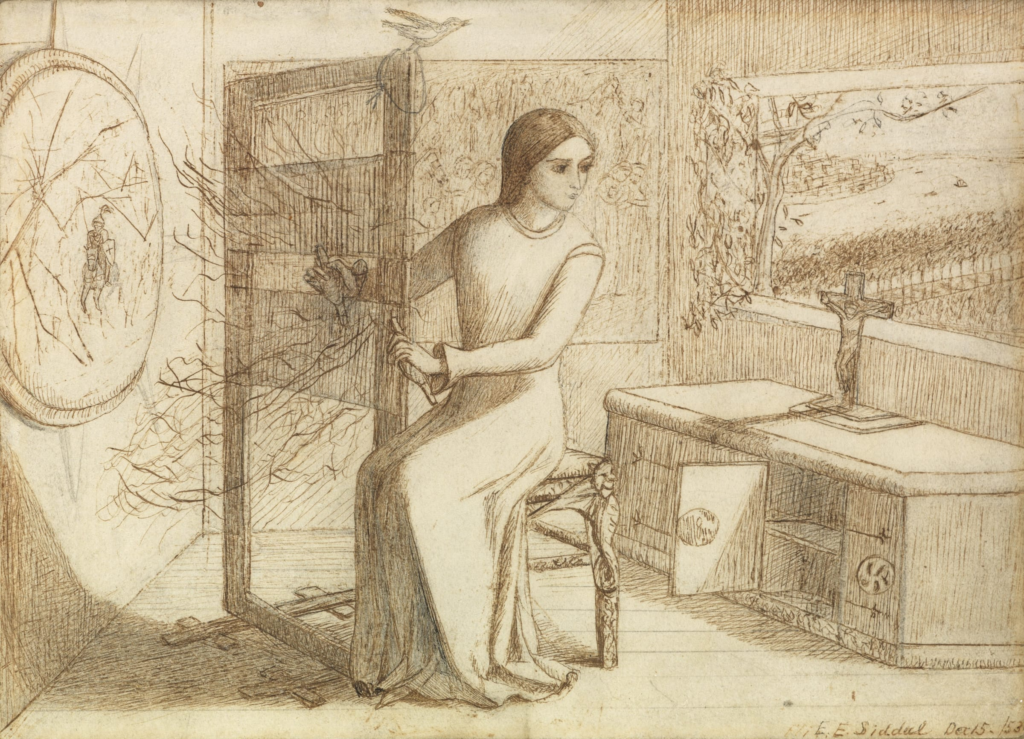
| Clio is a slice-of-life, historical LARP in three acts. It is loosely based on the history of the Pre-Raphaelite Brotherhood, a radical and reforming group of artists founded in London in 1848. Everyone who plays this LARP will both paint and model for a painting, but absolutely no painting skill is required – just enthusiasm. 1848. In a ramshackle studio in Fitzrovia, a secret brotherhood of artists meet to paint their muses. 1853. A group of women with famous faces gather in the New Forest to turn the tables. 1857. An exhibition at Russell Place brings all the players together again. This is an elegiac and emotional LARP about artists and their muses. It deals with themes of beauty, sexism, classism, power, and control. You don’t need to know anything about the history to play: an introductory workshop will provide you with everything you need. A game that’s well suited for those who enjoy getting under a character’s skin and getting creative. |
| Chloe Courtney is a UK theatre producer who has produced work with organisations including Complicite, the National Theatre, the National Trust, and the Barbican – as well as festivals and community spaces across the country. They are currently Executive Director of touring arts charity China Plate. In 2018 Chloe was introduced to LARP as a player. In 2024 they wrote and produced their first LARP ‘Comfort and Joy’ (Best Medium LARP, UK LARP awards) set in the 1930s world of the UK ‘A Foot on the Stairs’ LARP system. They are particularly interested in LARPs that encourage players to encounter history in new ways. |
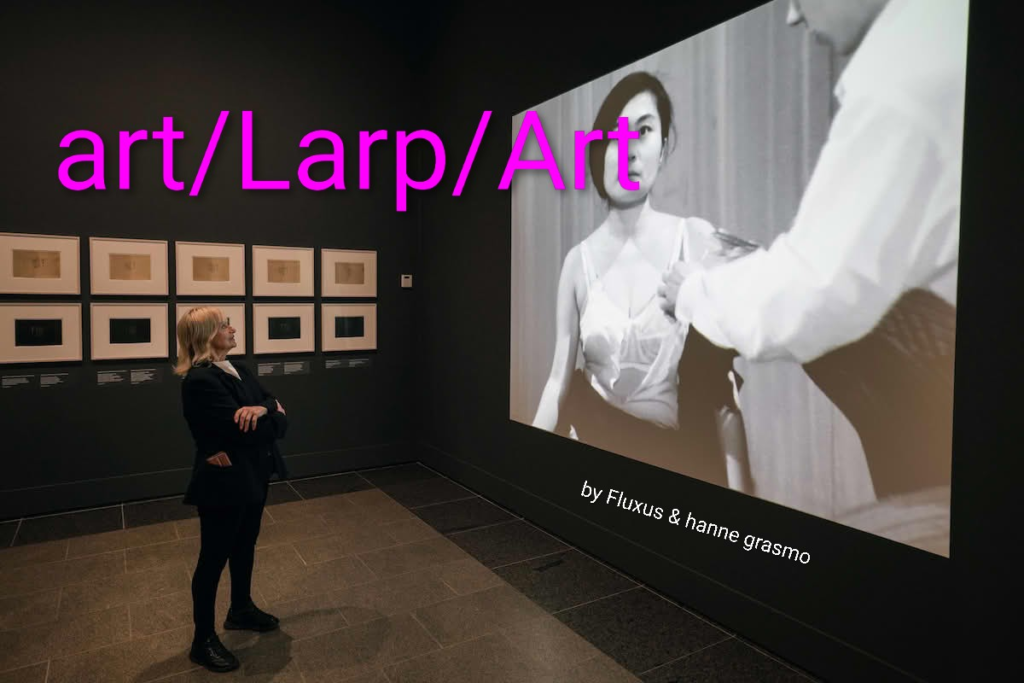
| art/Larp/Art (Ludus) |
|---|
| art/larp/art is performative artworks recreated as larps. A contribution to the discourse about art and larp. Feel free to join for fun as well. We larp three artworks originally created in the 60s and 70s, but with relevance for the art scenes of today: David Lamelas Time (1970), Alison Knowles Proposition #2 (1962) and Yoko Ono Cut Piece (1964). You will play the same character in all three events. Each larp will last for about 15 – 30 minutes. |
| Hanne Grasmo (in discussion with Flux art works). Norwegian designer, organizer and researcher of larp in the Nordic tradition. Sociologist employed by Larpocracy, doing PhD at Tampere University about Larp and sexual arousal, but care as much about art as activism and nature as salvation. |
Inner Worlds — Memories & Feelings & Trans Experiences (Video Games As Art session 3, 10:00-12:00, Paidia): Let me see the sea, Arce, BITE, TeNeBriSM, Trans Folks Walking, transitional roads
Memories & Feelings w/ host Mark Maletska
How do games capture an inner feeling? This session explores games that are closely tied to our inner worlds, whether about anxiety, grief, or longing for the sea. If you’re interested in human subjectivity and expressing our inner truths, this session will have games for you!
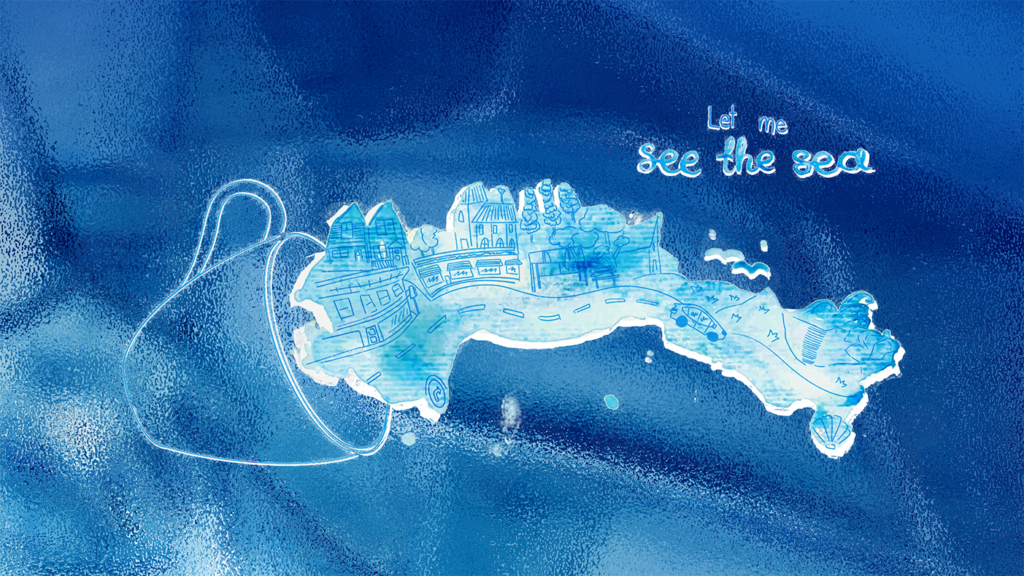
| Let Me See the Sea (point-and-click adventure) |
|---|
| Let me See the Sea is a point-and-click adventure about the longing for the sea and the experiences it inspires. Guided by an unknown narrator recalling her last trip, an ordinary morning unfolds into a memory-filled journey where you explore what lies behind this feeling. Through hand-painted gouache visuals, the game invites players to reflect about their own connection to the sea and what it means to long for something. The game was created to explore how digital media can translate and evoke the sense of “Sehnsucht”, a specific german concept of longing that has no proper english equivalent. |
| Katharina Faller (online presenter) is a multimedia designer from Germany, creating thoughtful interactive experiences across various digital formats. She studied Multimedia|VR Design at Burg Giebichenstein University of Art and Design in Halle, graduating with a Bachelor’s degree in 2026. “Let Me See the Sea” is her graduation project. |

| Arce (interactive poem) |
|---|
| ARCE is an interactive poem in which the author Heloise Arce explores her relationship with her heritage and with her own father. |
| Heloise Arce (presenter) is an artist and video game designer who has worked for years at her own studio, Dobra Studios. She is currently exploring the limits of the medium and the intersection of video games with other art forms. |
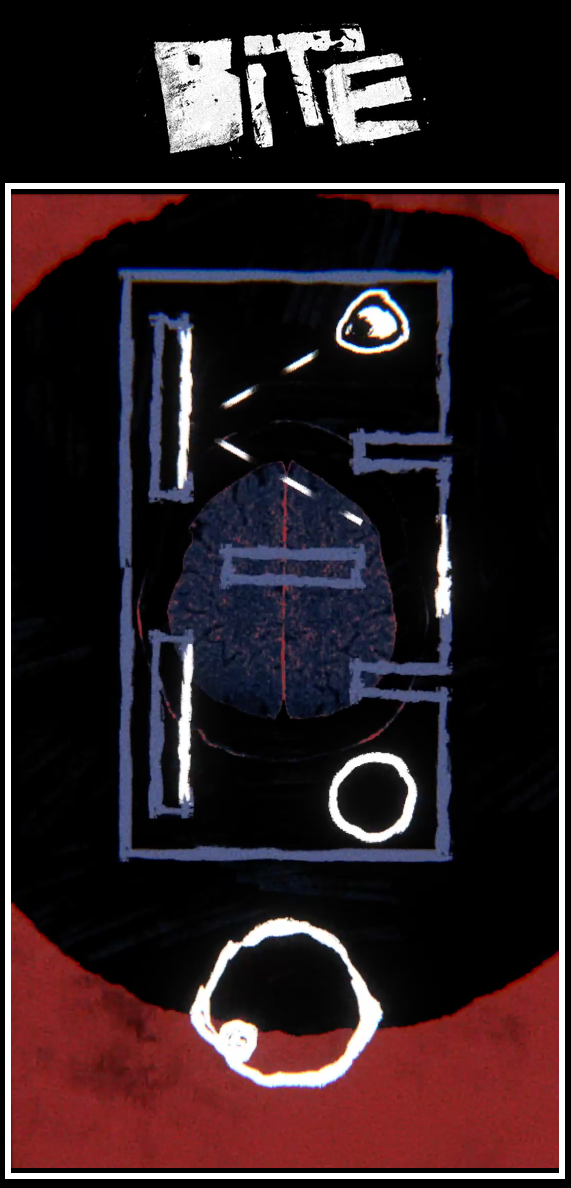
| BITE (mobile game) |
|---|
| BITE is a video game designed for mobile devices that puts you in the shoes of someone experiencing an anxiety attack. He doesn’t know why this feeling is taking hold of him, but he’s convinced that if he finds the cause, it will all stop. Each level is a new train of thought, a question that leads to another, an answer that’s never enough. It doesn’t matter if it makes sense; the important thing is to keep going. |
| We are Error Plaza (in-person presenters), a video game studio and/or collective made up of three people from Spain. Our games are an attempt to do our best with what’s wrong. We like to focus on social issues, mental health, and identity, but without losing sight of the mechanics and the value of interaction |
| TeNeBriSM (walking simulator) |
|---|
| TeNeBriSM is a playable album and walking simulator in which the player explores five levels representing the stages of grief. The 3D environments are visually inspired by brutalist architecture and surrealist art and filled with sounds that respond to the player’s presence. Following the five stages of grief, the levels’ visual and audio themes go through denial, anger, bargaining, depression, and acceptance respectively. The game started from a desire to create an experience with a greater focus on audio and visuals over more ‘game-like’ mechanics. Inspired by walking simulators like ‘Kid A Mnesia Exhibition’, our group came together ready to create a playable album where the environments and music are affected by the player’s movements. Through studying brutalist architecture, surrealist art, and electronic and progressive rock music, we formulated a visual and sonic language that wordlessly tells the story of a journey through the five stages of grief. |
| TeNeBriSM was created by Alexa Teta, Anderson Leroy, Aubrey Kennedy, and Emily Kapsalis (online presenters). Alexa Teta is the lead environmental designer and 3D modeler for TeNeBriSM. She designed all the 3D objects throughout the game. Her work commonly emphasizes exploration, focusing on environments that have a sense of mystery and enticement. Anderson Leroy is the sound designer, composer, and assistant programmer for TeNeBriSM, providing the sound effects and music to which the environments were built. His practice is heavily inspired by minimalism and often tackles themes of isolation and human relationships. Aubrey Kennedy is the technical artist for TeNeBriSM, developing the water system and creating concept art that helped shape each level. Additionally, she contributed to many other parts of development, including environmental design and acting as a shadow puppet model featured throughout the game. Emily Kapsalis is the lead programmer responsible for implementing the music, sounds, and environmental interactions of each level. She creates unusual game experiences inspired by abstract and surrealist art, as well as horror aesthetics. |
Trans Experiences w/ host Mark Maletska
This session focuses on games the represent the experiences of those who are in a gender transition. Taken from first person perspectives these games unpack various aspects of these complicated and critical inner worlds.
| Trans Folks Walking (narrative game) |
|---|
| Trans Folks Walking is a 3D, first person narrative game made with Unity that explores experiences of trans embodiment, being, and mobility drawn from the actual stories of trans community members. The game currently puts players in several situations drawn from the experiences of trans folks in contemporary America, ranging from the everyday such as using the bathroom through the particular such as being trans in a Christian church. The game creates space for trans folks to share their stories and for players to experience small parts of what it means to be trans. The game is intentionally designed as an anthology of short experiences that will grow in collaboration with trans people and their communities. |
| Trans Folks Walking has been created over a number of years by Cody Mejeur (project director), Famous Clark, Dana Hunt-Locklear, Austin Wilson, Madison Ford, Wes Turner, Angela Satullo, and Ellie Locatis (online presenters). It is an ongoing project of the Amatryx Gaming Lab & Studio at University at Buffalo, SUNY, a lab dedicated to gaming, virtual reality, social justice, and community storytelling projects. The lab combines cutting edge research on games, culture, and narrative with development projects in analogue, digital, and virtual reality games. Amatryx is committed to the diverse exploration of social justice narratives with intersectional queer and feminist values, such as antinormativity, relationality, coalitionality, and resistance. Cody Mejeur (They/Them) is Assistant Professor of Media Study at University at Buffalo, SUNY, and Director of the Amatryx Gaming Lab & Studio there. |
| transitional roads (video game) |
|---|
| Is there an alternative? Can we choose the path we are on? Who killed her? You find yourself part of a surreal investigation after an emotionally tense car conversation. ‘transitional roads’ is an experimental game experience, deeply rooted in the experience of discovering one’s own gender identity. It is about breaking conventions, about the simultaneity of trauma and escapism, of choice and powerlessness, of endings and new beginnings. |
| Always at the intersection of play, resistance and survival, Sasha Deetar (online presenter) tries to tell stories that encourage understanding: for non-human beings, marginalized people, but above all for yourself. Their work is characterized by a cut-into-pieces and put-back-together aesthetic, raw intimate narratives and a strong focus on immersive and intentional sound design. His games and interactive installations also regularly explore his interests in queer theory, surrealism, and the deconstruction of binaries and games in general. |
Video Games, Society, and Story (Participatory Workshop, 12:00-14:00, Paidia)
| Video Games, Society and Story workshop |
|---|
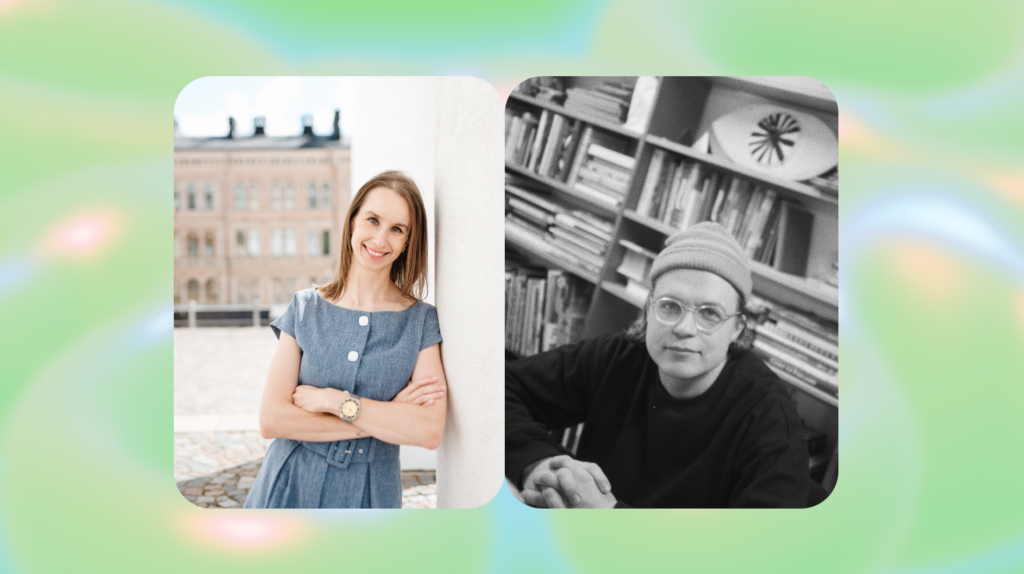
| Video Games, Society and Story workshop brings together ideas on how different forms of gaming, in connection with artistic thinking, can tackle contemporary societal issues and what kinds of characters and narratives we can use for these games. In the first part of the session, led by artist Tatu Heinämäki, participants will collectively develop ideas for games: what civic issues those games could investigate, in which contexts they would work, and what gaming logistics or artistic methods would be utilised. The second part of the workshop, with narrative designer Brooke Maggs, will focus on how to add characters and narrative elements that drive the game forward. Workshop is organised by Art and Media Culture Agency M-Cult, and is part of their Gaming the Civic programme. It brings together media art, game design, critical thinking, and the gaming industry. Gaming the Civic supports artists to create works that use digital games and emerging technologies to involve people as active participants in public realms. The duration of the workshop is 2 hours. Max amount of participants: 20 people. No need for earlier experience on game development or artistic work. |
| Brooke Maggs is an experienced narrative designer for video games and a fiction writer living in Helsinki, Finland. She has worked on award-winning indie games such as The Gardens Between, Paperbark, and Florence. She currently works at Remedy Entertainment where she has worked on the upcoming Max Payne Remake and Control. Brooke is also an interactive experience designer who works with contemporary artists and organisations on their digital installations and exhibits. She has collaborated with the Serpentine Gallery in the UK on Danielle Braithwaite Shirley’s ‘The Delusion’ and the ‘Inside/Out’ exhibition at the Melbourne Museum in Australia. Tatu Heinämäki is a media artist and game designer living in Helsinki. He studied visual arts in Tampere University of Applied Sciences and photographic arts and game design in Aalto University. His practice is focused on creating games that have something meaningful to say but don’t compromise on gameness and fun. Together with artist and designer Camilla Pentti, Tatu founded Part of Noise, a small game studio focused on games that engage in societal discussions through education, raising awareness, and information design. Tatu has been an art teacher for children and young people for the past 10 years. |
14:00-15:30 lunch recommendation: Toor shahzada
The Mystery of Connection (Larp As Art session 3, 15:30-20:00, Näty theaters): Where Love Happens, The Finnish Coffee Ceremony, Split Second, Superrealism
The Mystery of Connection
Love, society, interpersonal connection… It’s hard. It also can be mysterious. This selection of games explores the complicated interactions required to be a part of a relationship, whether romantic, socially polite, via a magic grocery store or as a conceptual piece of music. If you’ve ever wanted to be in love or feel confused about it, then this is the session for you!
| Where Love Happens (Teatterimonttu) |
|---|
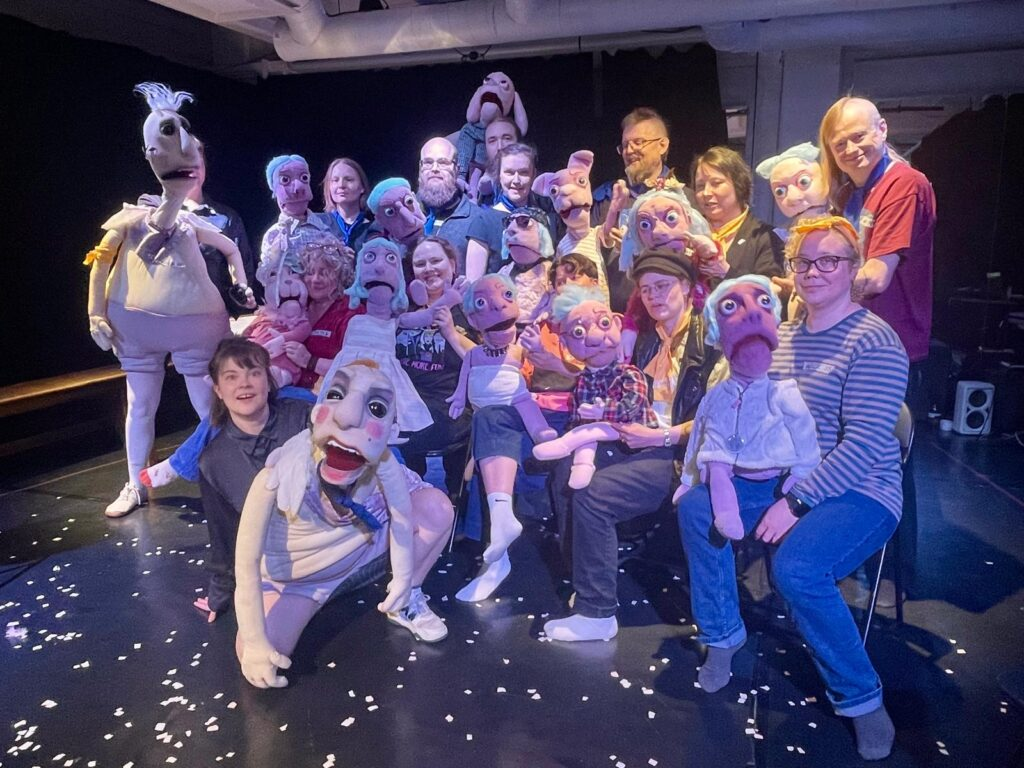
| “Do You believe epic love stories only happen on the silver screen? Think again! At Where Love Happens, we specialize in making Your romantic dreams come true. Powered by our advanced AI Aphrodite, our matchmaking process delivers a 99% success rate in finding Your One True Love.” Where Love Happens is a comedy about romantic comedies and their clichés. It combines larp with puppetry. You will get to play together with human-sized Cupid puppets manipulated by professional puppeteers, and use a smaller puppet to represent your character in some scenes. You will play a customer at the romantic consultation agency Where Love Happens that is run by two Cupids – magical creatures with special powers. The agency promises 99% chance of finding your True Love. |
| Kaisa Kangas is a Finnish larp designer and author with 30 years of experience on the field of larp. Essi Santala is a Finnish theatre lighting designer and larp producer. Tonja Goldblatt is a Finnish artist who has worked in participatory arts for over 25 years and is currently active in the international Nordic larp community. Helena Markku is a puppet theatre artist based in Turku and serves on the board of the Aura of Puppets network. Elena Rekola graduated as a puppet theatre artist from Turku Arts Academy in 2018. Riina Tikkanen is a Helsinki-based performer and puppet theatre artist. |
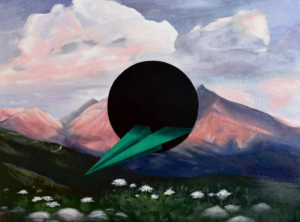
| Superrealism (Black Box Rehearsal Space) |
|---|
| In a remote country house, you hesitate. The esoteric new-age self-development seminar is about to begin. Promptly, however, the escalating ceremony leaves your ego behind. The spiritual pilgrims begin to hungrily explore the associative, symbolic, and synesthetic planes of remedy. Whisper! Mumble! Cry out! Far in the distance, the Mountain grows and growls. To find its heart, the pilgrims need to traverse surrealist scenes of avant-garde innovation. Gratefully, they are aided. The music of the world is their wind, their bodies are the wings. Pace! Skip! Swirl! Yet, the path is uncertain. Will the pilgrims ever find the Blackbird of the Ridge, the infinite emotional expression of self-dissolving unity, the moment that they could call the present? SUPERREALISM is an experimental music-driven game about looking for and finding. The game is played without verbal expression through embodied expression. |
| Lauri Lukka, D.Sc., is a Finnish psychologist and designer specializing in digital therapeutics for mental health. Since 2011, he has created numerous role-playing scenarios, including Prelude, and the music games trilogy consisting of Superrealism, Wonderworks, and Rap Superstar. He also co-organizes Stoori: Helsinki Freeform Festival. Scientifically, he has explored design, immersion, and roles in games. |

| The Finnish Coffee Ceremony (white box rehearsal space) |
|---|
| Have you heard of the Finnish Coffee Ceremony? It goes like this: “The coffee is on the table. Please take some coffee!” This invitation inevitably produces tension; no one moves toward the coffee table, and the invitation must be repeated several times. — After several invitations have failed to elicit a response, a hostess (or her husband) may announce in an irritated tone of voice: “The coffee is getting cold.” If all else fails, the hostess may turn directly to one person and choose some relatively insignificant reason to get her to go first.” The Finnish Coffee Ceremony draws on the above-cited article by Fredric M. Roberts, “The Finnish Coffee Ceremony and Notions of Self,”. While the premise may sound comedic — especially to Finns — the intention of the game is to explore players’ and their culture’s relationship with dependence, needs, and the pressure to appear self-sufficient. Would you like some coffee? |
| Pauliina Männistö is a Finnish role-player, designer, and organizer whose work focuses on creating larps accessible to both experienced participants and newcomers. She is currently completing her MA in Transformative Game Design at Uppsala University, where she has concentrated on integrating her experience in leisure larp, organizational development, and philosophical practice. Her future research interests include ethical theory and applied ethics within the context of larp. She is also an analogue photographer, and regards both larp design and photography as practices of co-creation; they both feel like collaboration filled with magic. |
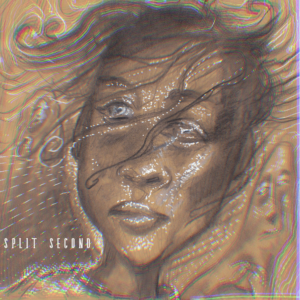
| Split Second (Ludus) |
|---|
| In the short non-verbal blackbox larp Split Second, the players experience a sleepy afternoon in a grocery store, where their respective sense of loneliness and fantasy transports them to a shared split second of dreaming and making the mundane magical. One is a child, seemingly left alone in the store, another is the shoplifter trying to fix dinner, the third is the cashier working overtime, and the fourth is the janitor who does not speak the language. The larp is divided in three acts and the facilitator is the meta voice, the intercom, adds these cues combined with the music. In the first act, the players engage in the mundane reality of being in the shop, walking through the aisles. In the second act, time stops and the players are now faced with an alternative and magic reality emerging in the shop where the people are no longer who they seems to be. In the last act, the strangeness of the fantasy lingers as time continues in a boring way and the players have to decide on what to do with the residue of what happened. Was there something real that was shared in that Split Second? |
| Sara Sheikhi is a Swedish Nordic larper and writer. She works with language, other interests are music, drawing, and learning. She is interested in vulnerability and play, amongst some themes. Her writing spans from academic writing to poetry. Former larps written by Sara is notably “Mall Rats” and “The Questgiver”. Drawing by Sara Sheikhi, all rights reserved |
Anti-Nostalgic Histories (Video Games As Art session 4, 15:30-17:30, Paidia): Thousand Lives, Dear Macedonia, Echoes Under the Mine, Syphilisation, The Forgotten Ones
Anti-Nostalgic Histories w/ host Joleen Blom
Sometimes we look at history through a pair of rose-tinted glasses. This is not that. These games take a pragmatic, critical realist approach to history. If you’re interested in how complicated times are depicted in games, then this is the panel for you!

| Thousand Lives (Interactive Story) |
|---|
| Story of a woman swept away by the currents of history. Thousand Lives is an interactive story about a woman born in communist Poland. It follows her life throughout the decades and your choices define how it unfolds. Will you be a dissident or toe the party line? Whose side will you take in a torn family? What can you sacrifice for wealth and comfort? Either way, you have to live with your choices. There’s no do-overs or restarts. It’s an email-based story. There are six chapters and each day you will receive a new one, based on the choices you made earlier. |
| Wojtek Borowicz (online presenter) is a writer, narrative designer, and an award-winning dungeon master. Some of his notable works include Thousand Lives, email-based interactive fiction that was featured at NarraScope 2025, and Campfire, a tabletop role-playing game awarded Best Adventure at Gaelcon 2023. Wojtek comes from a professional background of over a decade in technical and instructional writing in the tech industry. Originally from Poland, he’s currently based in Dublin. |

| Dear Macedonia (Poetic Non-game) |
|---|
| Dear Macedonia is a first-person non-game invites the player to walk through a virtual landscape shaped by memory, displacement, and inherited history. The terrain is based on topographic data of the Grammos mountains, an area crossed by many families fleeing the aftermath of the Greek Civil War. Among them was the artist’s grandfather. There is no score, no enemy, no victory condition, and no clear destination. The player simply continues walking. Along the way, fragmented archival testimonies emerge from the landscape, turning the environment into a space of listening rather than action. |
| Vojtěch Radovský (in-person presenter) is a Prague-based new media artist, audiovisual performer, musician, and creative technologist. His practice combines real-time 3D environments, interactive installation, sound, video, and game-like formats. He works mainly with Unreal Engine, TouchDesigner, Blender, Ableton Live, and spatial sound systems. His artistic work deals with memory, displacement, emotional inheritance, sensitivity, and the fragmented relationship between personal and collective history. He is interested in creating immersive spaces where the viewer does not only observe a story, but enters, navigates, and listens to it. |
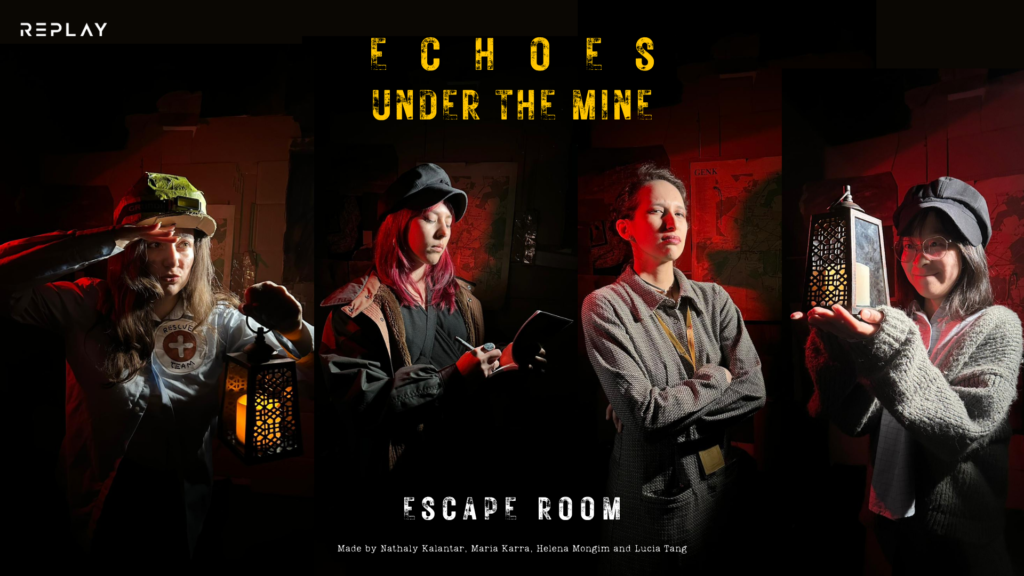
| Echoes Under the Mine (Hybrid Escape Room) |
|---|
| Echoes Under the Mine is a hybrid play experience inspired by the Zwartberg mining disaster and the history of migrant workers in Genk, Belgium. Players move through a dark underground space using flashlights, fragmented documents, audio communication, and physical interaction to uncover the stories of miners lost inside an industrial system that slowly erased them. The experience mixes escape room mechanics, environmental storytelling, and installation art to create a tense and intimate journey through memory, labor, migration, and loss. Players search through abandoned spaces, connect clues, and piece together personal stories hidden beneath layers of dust, machinery, and silence. |
| Nathaly Kalantar (in-person presenter) is a Peruvian-Iranian game designer, producer, and interdisciplinary creator currently studying in the Erasmus Mundus REPLAY Master in Game Design. She is particularly interested in how games can operate beyond entertainment as artistic, educational, and cultural spaces. |
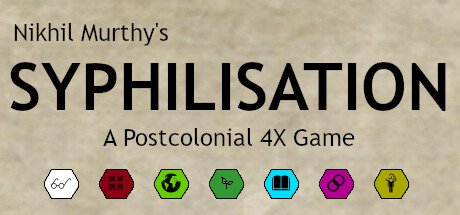
| Nikhil Murthy’s Syphilisation (4X Game) |
|---|
| Syphilisation was built to be a postcolonial answer to the 4X genre. It took the standard patterns of 4X games and devised postcolonial alternatives to all of them. In particular, it demonstrates that the twin pillars of winner-take-all and growth-for-the-sake-of-growth are not necessary for a 4X game and that more humane alternatives exist that align better with the values of the players and designers. Syphilisation is a 4X game that’s not nationalistic, that’s not imperialistic and that’s not insane. The real world isn’t zero-sum. This is a game where you can try empathy. Wars of opportunity are unethical and if you want to play opportunistically, I’m not going to stop you, but I’m not going to pretend that you’re clever for doing so. Syphilisation is a game that wants you to be better. |
| I’m Nikhil Murthy (in-person presenter) and I make games that expand the breadth of what can be expressed with games. |
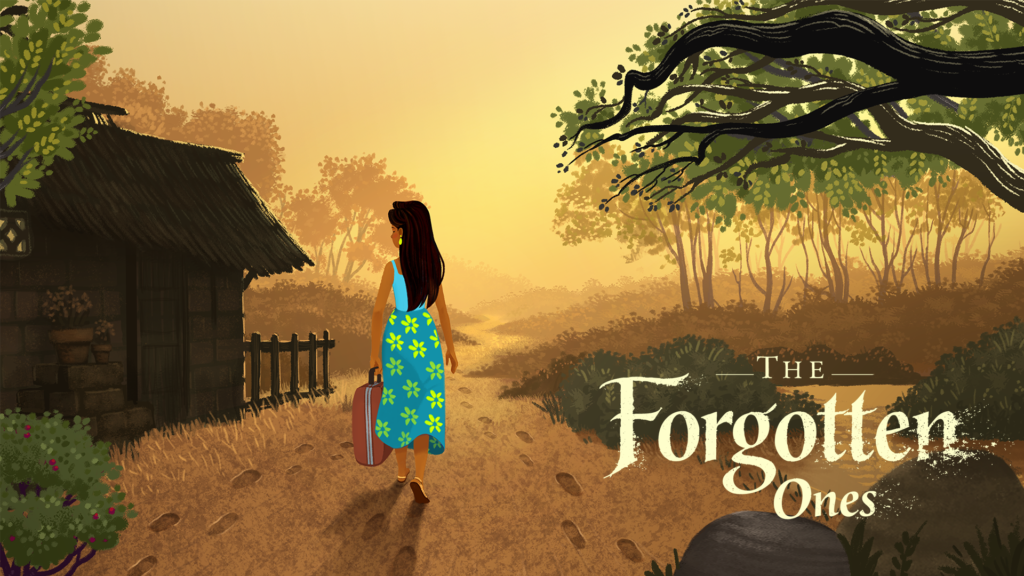
| The Forgotten Ones (Video Game) |
|---|
| Leidy dreamed of the city, she never imagined violence would force her there. In this 90s narrative adventure, explore streets and interiors, inspect traces people left behind, hear conflicting family memories, and reconstruct meaningful objects by hand while restoring what violence left unfinished. |
| Blazing Soft (online presenter) is an independent game studio based in Colombia, formed by 10 people from different regions of the country. To build The Forgotten Ones, we bring together artists, programmers, designers, writers, and producers — with women holding key leadership roles across the studio and its productions. Our identity is built on diversity, curiosity, and craft, shaped by years of independent production — from early prototypes to a fully realized narrative world. We use games as a medium to preserve cultural memory, open dialogue, and connect communities, and that mission runs through every discipline on the team. |
Nightmares and Fantastical Worlds (Video Games As Art session 5, 17:30-19:30, Paidia) Little Nemo and the Nightmare Fiends, Amaterasu in Hell, Epsilon Aurigae, SCP: Mr. Jupiter, Courier
Nightmares and Fantastical Worlds w/ host Oz Buruk
Let your imagination take flight- into a pit of various torments! These games provide the magical essence of being stuck in space, lost in your nightmares, thrown to hell, and having giant pianos whisper things into your ears.
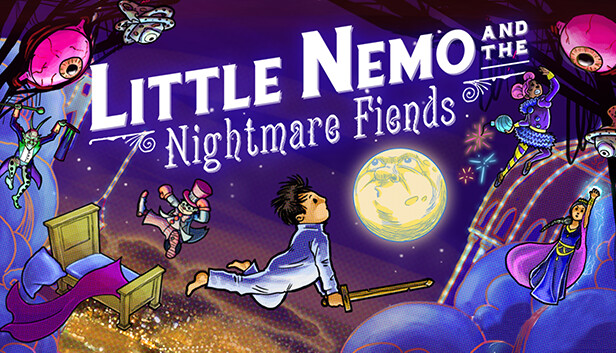
| Little Nemo and the Nightmare Fiends (video game) |
|---|
| Slumberland, the land of dreams, is in danger, and the royal family has summoned a small boy, Nemo, to fend of the Nightmare Fiends. Little Nemo and the Nightmare Fiends follows characters from Winsor McCay’s landmark 1905 (and public domain) comic strip, Little Nemo in Slumberland, on a hand-animated adventure. Winsor McCay is one of the most important figures in both comics and animation. The game examines his artistic legacy through its art style, which recreates the look of the original comic while adding elements of later works that were influenced by McCay, while updating elements for modern audiences. The result is a game that uses game art as a critical framework. |
| Team Nemo, Inc. (Online presenters) is an award-winning game developer collective of Chris Totten, Ben Cole, Adrian Sandoval, and Max Kunze. Chris is an associate professor at Kent State University whose work focuses on the intersections of games and the arts. Projects in this area include co-founding the Smithsonian American Art Museum (SAAM) Arcade, the book An Architectural Approach to Level Design, and creating games based on works of art and literature. Ben Cole is a game developer with over 20 years of experience, including working at Bandai-Namco on multiple original and licensed games. Adrian Sandoval is a game designer, historian and design instructor at Drexel University. He and Chris co-authored the book World Design for 2D Action-Adventures. Max Kunze is a game and level designer who has worked with multiple development studios. His personal work includes art games that examine the aesthetics of late 90’s and early 2000’s computer hardware. |
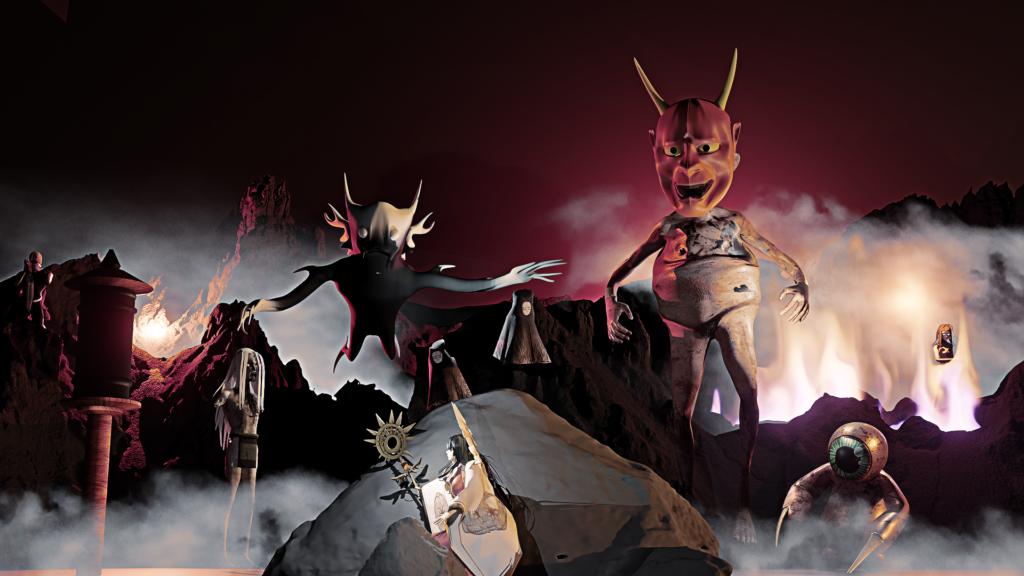
| Amaterasu in Hell (video game) |
|---|
| Amaterasu in Hell tells the story of a goddess who isolates herself in a cave to cut ties with the world. Confronted with her own thoughts, she remembered how she had hurt the closest people she had. She then decides to go to hell to rescue them. The player will control the Japanese sun goddess Amaterasu, evolving through different hell levels. The game offers a variety of approaches and gameplay to fit the gamer’s will. It is all about fitting in or not in the unknown. The sun goddess carries a strong power of light, and her presence disturbs the balance of the hell dimension. The player should constantly choose between using her power, which is the opposite of the shadow world, or being mindful and acting discreetly. The adventure aims to put the impact of our choices on the environment in the foreground, and the difficulty of being a foreigner in an unknown world. |
| Joachim Penon (in-person presenter): French artist living in Finland for over a decade, he used to paint, draw, and craft installations. From resident artist to graphic designer, passing by bakery owner to manager of a suhibar, or more recently video game tester, Joachim decided in 2022 to pursue his dream to study Digital Media. Presently a 3D generalist, one of his main interests is game design. Surrounded by several video game enthusiasts and a few game projects later, he is now producing, in the last year of his studies at TAMK, a video game that he is proud of. |
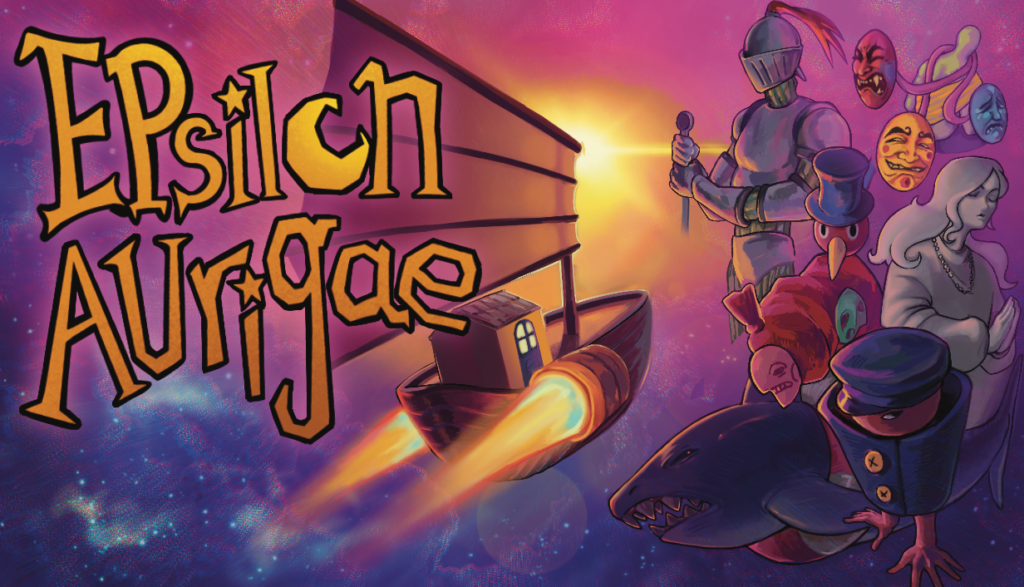
| Epsilon Aurigae (video game) |
|---|
| In Epsilon Aurigae you are traveling through space with the speed of light until your hyperdrive breaks down. You are stranded in a nebula that is inhabited by peculiar creatures and it is your job to find a way to fix your broken hyperdrive by helping the nebulas residents. |
| Electric Kittens Studio (in-person presenters), Tuukka Rintala (Project manager and programmer), Kai Lindegren (Producer and programmer), Isaias Kinnunen(Art directior and artist), Otto Haavisto (Artist), Niloufar Biglary (Artist), Julia Kurkela (Artist), Suvi Ahtikari (SFX), Jaakko Kuorikoski (Music & SFX) |
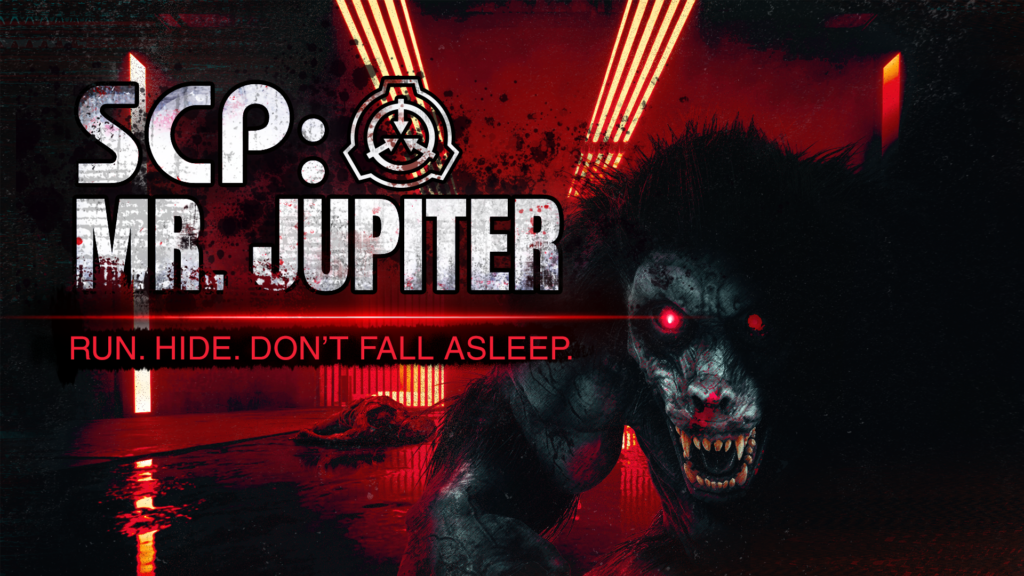
| SCP: Mr. Jupiter (video game) |
|---|
| SCP: Mr. Jupiter is a first-person horror-comedy adventure set inside a collapsing SCP Foundation facility. You play as a Class-D personnel member who emerges from a bathroom stall at the absolute worst possible moment. The site is already in chaos, security systems are failing, and the anomalous entity known as Mr. Jupiter is now roaming free. Armed with nothing but your wits, questionable luck, and a strong desire to survive, you must navigate the facility, avoid deadly threats, solve environmental challenges, and find a way out before everything goes from bad to worse. |
| AHISD STUDIOS, Melih Tasci, Paavo Huttunen, Adem Deriouche. TAMK Games Academy Last year students. |
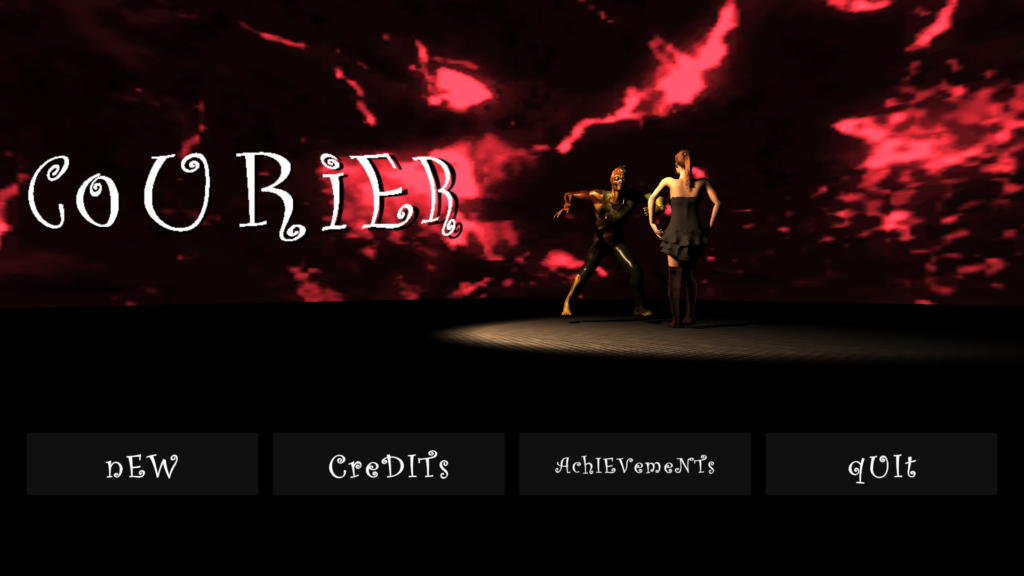
| Courier (video game) |
|---|
| Courier blends the uncanny beauty of surrealist art with spatial puzzle design that defies ordinary logic. Every new game shifts the world around you, rewarding curiosity and making you question assumptions. Visually striking and quietly strange |
| Petri Lankoski is a professor of Media Technology who studies games and occasionally creates them. |
W.A.I.T — Why Am I Talking/Why Aren’t I Talking? (Participatory Lecture Performance, 19:30-20:30, Paidia)
| W.A.I.T (Why am I Talking / Why aren’t I Talking) |
|---|
| W.A.I.T. is for anyone who has ever edited themselves in a room. This participatory lecture performance playfully looks at how groups self govern amid rising digital mediation: negotiating when to speak, when to hold back, and who gets to decide. The experience stages collective choreographies of agreement, moderation, and what it means to prove you are human. Explore the histories and rituals of community agreements, UX/UI design, and online consent protocols through this playful guided performance. Please bring a mobile device capable of connecting to the internet. |
| Kristin McWharter uses performance and play to interrogate the relationship between competition and intimacy. Her work conjoins viewers within immersive sculptural installations and viewer- inclusive performances that critically fuse folk games within virtual and augmented worlds. Her software installations and performative objects incorporate experimental technologies and playful interaction to produce performances that speculate upon alternative forms of social behavior. Inspired by collective decision making and technology, her work blurs the boundaries of intimacy and hype culture to challenge viewer’s relationships to affection and competitive drive. Her work has been exhibited at The Hammer Museum, Walt Disney Concert Hall, Bangkok Arts and Cultural Center, Ars Electronica, Museo Altillo Beni, and FILE Festival. McWharter is an Associate Professor at the School of the Art Institute of Chicago where she teaches in the vArt & Technology / Sound Practices department. |
Social Program organized by Hanne Grasmo (22:00-late, Screening of Film Open Call by Sille Storihle in Paidia (old link) or (22:00-1:00, Taverna board game night: old link).
Sunday October 11th
Touching Grass and Blowing Up Pipelines: Actions of our Eco-Future (Main Showcase Session 1, 10:00-14:00, Paidia): Treeplanter, ReLeaf, How to Blow Up a Pipeline, Beneath Our Feet
Touching Grass and Blowing Up Pipelines w/ expert panel Daniel Fernández Galeote, Venni Kauppila, Antonio Rodrigues, Cici Liu
The globe is warming. The climate is changing. The eco-system is footprinted by carbon. So like… what are humans going to do? These games discuss how we can relate to the climate in the future. Some of these games focus on our impacts on climate, some on curating nature, some on systematically dismantling oil companies. There’s a diversity of options.
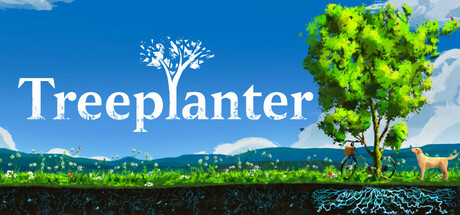
| Treeplanter (Simulation) |
|---|
| Welcome to Treeplanter, an interactive woodland that changes with the seasons. Piece together a small grove of trees. Watch as their roots blossom under the soil. Based on what you place and build, an ecosystem of animals, plants and birds will move in, turning your creation into their home! Each copy of the game sold helps Henry plant trees, wildflowers, meadows and community orchards through partnerships with schools, farms, communities and woodland charities. This means you’ll help restore real-life nature, too!! During development last year, Henry planted 900 trees on farms and schools in Suffolk. We’re on track to plant 8000 trees and millions of wildflowers in 2026. Combining meditation and education, Treeplanter aims to teach players about the interconnected wonders of the natural world, above and below ground. I wanted to share the beauty of trees, seasons, and sunsets, as well as create a game focused on climate action. |
| The Treeplanter prototype was co-created with a small team of rural young people, aged 18-20, they created the majority of the art, visual effects and also did cool things like the fungi and root growing systems! They were paid and mentored thanks to funding from the Eastern Education Group, and were directed by me (Henry). Then we finished Treeplanter off with help from talented friends. Big thanks to everyone, especially Rianna Suen (lead code) and Halime Karaca (lead art). Henry Driver (online presenter) is a sixth-generation farmer and digital artist creating video games (using solar energy) to connect players with nature and enable real-world change, including planting hundreds of trees every year on local farms and schools. Driver’s games have been exhibited in Tate Britain, Tate Liverpool, Sainsbury Centre and the Barbican, as well as other festivals and events worldwide. Previous clients include BBC Arts, Science Gallery, ARM, and Red Bull. |
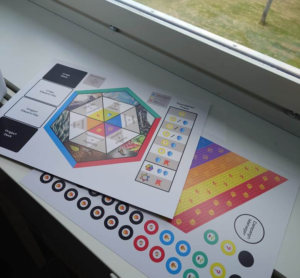
| ReLeaf (board game) |
|---|
| ReLeaf is a collaborative region-building game with a push-your-luck mechanic. Players come together to propose projects to implement and campaign for resources while trying to fight environmental crises. The goal is to build a resilient ecosystem with a strong social foundation to avoid environmental collapse. The game aims to inspire players to think about possible futures, and ways to come together to change the course of our world and our communities. It incentivises discussion and consensus building and stresses the importance of a holistic approach that incorporates the social, environmental, and economic, and not only technical solutions. |
| The game is designed by Tatu Kähärä and Antonio Pomposini (in-person presenters), two game designers and game studies researchers with an interest in the social, historical. And meaning-making capabilities of game. They are designing the game as part of Atacama, a company focused on regional regeneration, working with municipalities and companies to create circular economies. |
| How to Blow up a Pipeline – The Game (video game) |
|---|
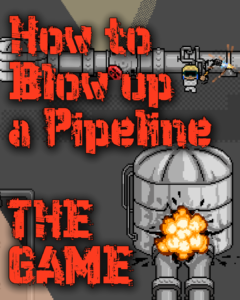
| A game based on the book “How to Blow up a Pipeline” by Andreas Malm. In the book, Malm argues for a radical flank in the climate movement and that violence against property might be necessary and justified in the face of the climate crisis. Since world leaders have so far not done what is needed to preserve a liveable world we may have to take it upon ourselves to start dismantling the fossil industry. The game depicts a direct action against an oil refinery and the player is tasked with doing as much economical damage as possible while trying to not get caught by security. |
| Art and game design by Kristofer “Kritzlof” Vaske (online presenter) and music by Chika Obiora of Echo and Awe sound. I (Kristofer) am an artist, game developer & parent with an interest in halting climate catastrophe. In that vein I try to develop games and projects that in different ways bring awareness to and encourage action and resistance in the face of the increasing crises of pollution, biodiversity loss and global warming. |
| Beneath our Feet (hybrid game) |
|---|
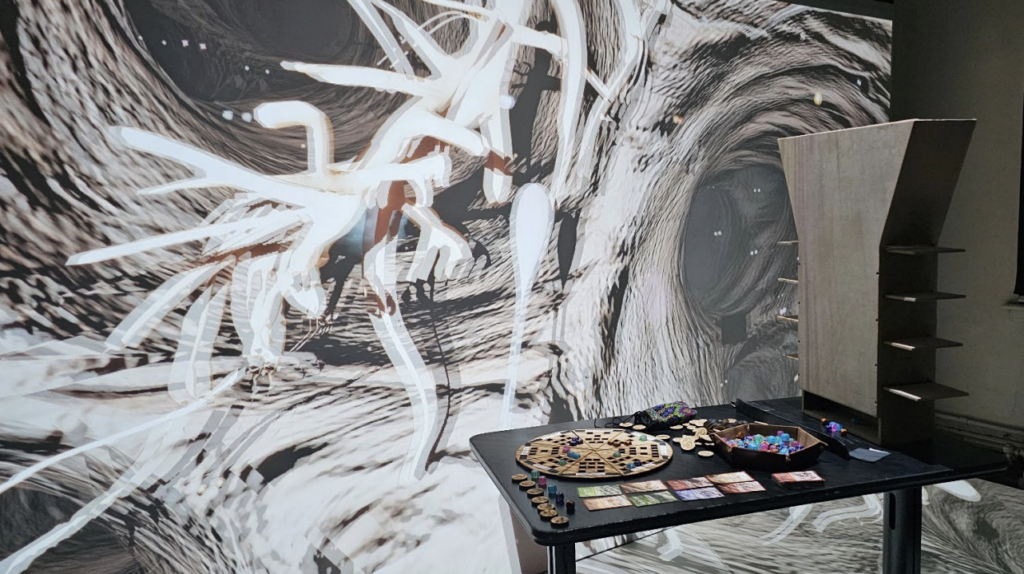
| Beneath our Feet is a digital and tabletop game that connects systems at the scale of human activity and environmental events with the hidden world of soil microbes. The goal of the game is to increase care and appreciation for microbes and their overlooked world. The rhizosphere, the layer of soil around the roots of plants, is home to teeming colonies of microbes that are essential to the health of the soil. Increasing understanding of the interrelated webs of terrestrial microbes, soil, plants, natural systems and human activity translates not just into better public understanding of the impacts of climate change, but also to practical and actionable strategies for climate resilience for farmers, forest managers, and all of us whose food and livelihoods come from the earth. In this artgame installation, players in the digital and analog tabletop games connect human-scale systems with the world of soil microbes beneath our feet. |
| Silvia Ruzanka (in-person presenter) is an Assistant Professor in the Department of Games and Experiential Media at Rensselaer Polytechnic Institute. She is an artist-philosopher whose projects include animation, virtual reality, interactive installation, and experimental games. She received her MFA in Art and Technology Studies from The School of the Art Institute of Chicago, and Ph.D. in Visual Arts: Philosophy, Aesthetics, and Art Theory from the Institute for Doctoral Studies in the Visual Arts in Portland, Maine. Her work has been presented nationally and internationally at venues including the Museum of Contemporary Art, Chicago; InterAccess, Toronto; the City College of New York; Georgia Southern University; SIGGRAPH; ISEA; the New Forms Festival in Vancouver; the Hong Kong-Shenzhen Biennale of Urbanism/Architecture; Game Happens in Genoa, Italy; and FILE, the Electronic Language Festival in São Paulo, Brazil. |
14:00-15:30: Lunch recommendation — Aloha Ramen
Using AI as a Mirror: Remediating the Human (Main Showcase Session 2, 15:30-19:30, Paidia): Defence Contractor Fantasy World, World Reworded, C’est La Vie, Game of Possible Lives
Using AI as a Mirror w/ expert panel Swapnesh Samaiya, Arttu Lakkala, Jurgis Peters, & Tero Alatalo
How does AI depict, describe, and construct a “human”? What themes emerge? What about a human life will it show and in what way? How will AI change our view of humans? These games use AI as a theme and as an engine demonstrating insights to these questions.
| Defence Contractor Fantasy World (Installation) |
|---|
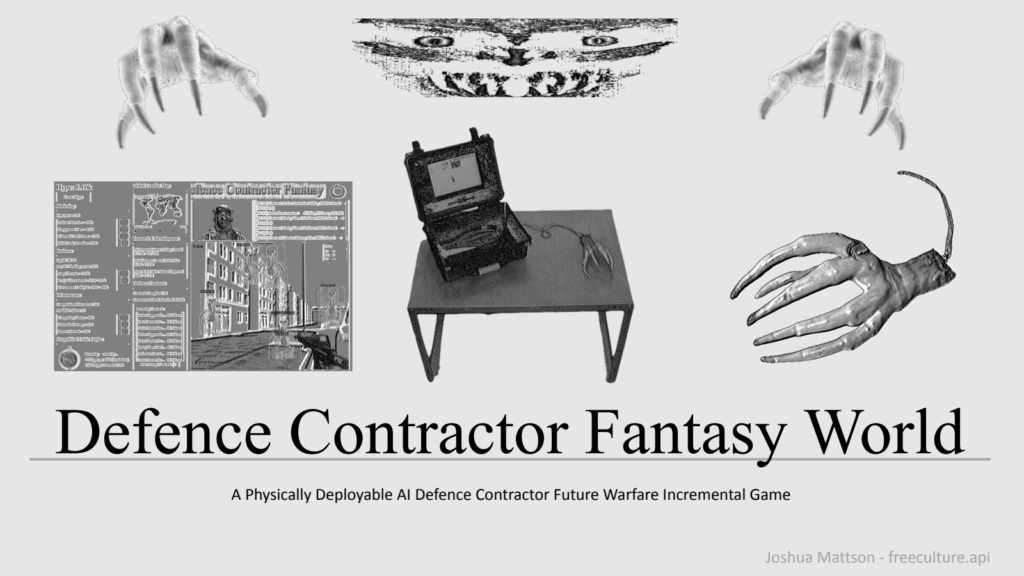
| Defence Contractor Fantasy World is a physically-deployable-incremental-game demonstrating the violent progression of AI-powered warfare concealed behind digital veils. The game interface is inspired by real-world AI-amplified portable computer interfaces like “Skykit” that put whole networks of automated sensors, weapons, and analysis systems into the hands of a single operator to amplify the speed in which destruction can be inflicted. The artwork is designed to put you in direct contact with a simulation of these real world automated systems while physically experiencing the disturbing physical impacts through holding hands with this grotesque controller. This “Incremental” game genre consists amassing in game resources and automating actions for exponential growth and progress. Through gameplay and physical touch, the loop of world events in which these defence contractors are able to gain power and influence is communicated to the user. |
| My name is Joshua Mattson (online presenter). I’m a Canadian game developer, animator, and media artist. Under my art alias “freeculture.api” I make games, animations, and installations related to internet spirituality, demystifying hidden networks, and hauntological 3D imagery. Currently I am doing my masters degree at the “Interface Cultures” program in Linz, Austria. |
| World, Reworded |
|---|
| “World, reworded” is a walking game about writing poems from ordinary surroundings. Players follow small prompts, take a walk, and record objective things they notice. Through poetic diffusion, each plain observation branches into subjective poetry. At the end, the poem is printed as a receipt — a small trace of how one place became another world through language. |
| Rauhel and Rooster (in-person presenters) are designer-researchers working across games, XR, and interactive art. Their collaborative work explores how artificial intelligence, embodied perception, and everyday environments can shape poetic experiences. In world, reworded, they invite players to walk, observe, and transform ordinary surroundings into subjective poems through language. |

| C’est la vie! |
|---|
| “Play the cards that life deals you”—C’est la vie! takes this expression literally. A deck of cards is a very powerful image of the reservoir of events that can happen to someone throughout their lives. Of all these possibilities, which ones will show up in your hand? And which ones will you play? In a medium dominated with narratives of epic proportions, C’est la vie! foregrounds the tragicomic dramas and triumphs of daily life: learning to walk, a first kiss, or discovering a grey hair. Borrowing from traditional game design structures, the game gently ironizes on contemporary performance culture, framing each life stage as a level to pass and quantizing happiness as a metric: can you win at life? The choice of AI imagery is a deliberate aesthetic exploration. To grapple with what these images really mean for us, we need to bring them home, as close as possible, depicting the most human things possible. This juxtaposition exacerbates diffusion models’ aesthetic peculiarities: all at once familiar, uncanny, cringe, hilarious. |
| Jonathan Lessard, Phd. (Online presenter) is a long time experimental game designer, researcher, and teacher. Professor in the Design and Computation Arts department of Concordia University, Montréal; holding the Behaviour Interactive Research chair in Game Design. |
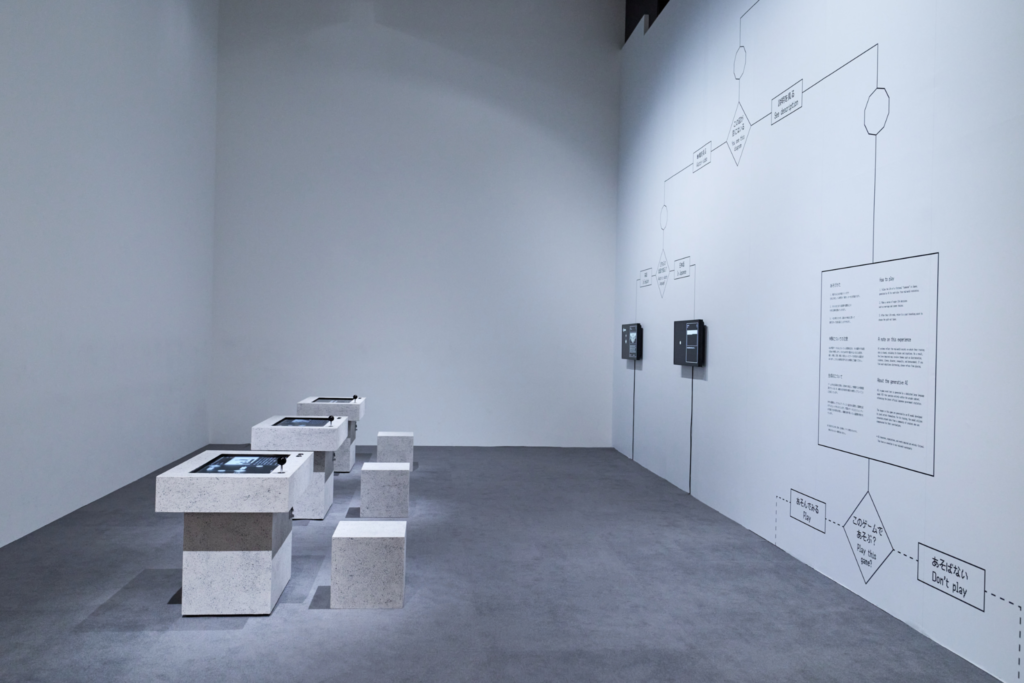
| Game of Possible Lives (arcade cabinet) |
|---|
| Game of Possible Lives is an arcade cabinet where a locally running AI narrates a statistically plausible human life. Players guide their character through major crossroads in education, work, and relationships, and live with the consequences of each choice until death. When a life ends, players may return once to an earlier decision and follow the road not taken. Each life begins as a fictional person, where age, gender, income, and residence are assembled from a country’s national census data into a combination that could plausibly exist in that country today. The version shown at Mori Art Museum’s Roppongi Crossing 2025 draws on Japan’s latest census data. Every text is generated by Gemma 3, an open-weight language model running locally inside the cabinet. Because such models are trained on vast amounts of human text, the worlds they produce mirror the present, its patterns and its biases. The plausible lives they generate open up questions about the values and assumptions embedded in our society, and how they are reflected back to us through AI. By preserving the model as it exists today, the cabinet becomes a living archive of the present, a distorted mirror of the forces shaping life now. |
| Tomo Kihara (in-person presenter) is an artist and game designer who explores play as a form of shared inquiry. Through experimental games and playable installations in public spaces, he creates situations where people can collectively explore how emerging technologies such as AI are transforming our societies and ways of thinking. His work has been presented internationally at venues including the Victoria & Albert Museum, the Mori Art Museum, and the Asian Art Museum, and has also received awards from the European Commission’s S+T+ARTS Prize and the Mozilla Creative Media Awards. |
Festival Closing by Leland Masek, Director of the Games As Art Center. (19:30-20:00, Paidia)